3m0tioNs
Stereo movement without the usual volume-panning trick. Tiny changes in delay make sound shift, lean, and move.
Movement you can feel.
Instead of pushing volume from one speaker to the other, 3m0tioNs moves the timing of the signal in tiny amounts. That creates a different kind of stereo motion.
Get 3m0tioNs on Gumroad Pay what you want · $12 suggested · VST3 + Standalone · Windows + LinuxSo, what does it do?
Move your stereo sound without simply swinging the volume from side to side. 3m0tioNs gently shifts timing and pitch to make the sound feel alive.
Curious how it works?
Four modulators, no shared clock.
Inside 3m0tioNs there are four completely separate modulation engines — one each for Left, Right, Mid and Side. They don't share an LFO and they aren't the same wave offset by a phase amount; each has its own Shape, Rate (0.02–8 Hz), Direction (forward or reverse) and Depth, and its own random seed so the Drift wobble pulls each one a different way. That's what stops the motion sounding mechanical: the two sides of the image are genuinely doing different things, so the result reads as a moving space rather than "there's an LFO on this."
The nine Shapes are the vocabulary. Sine is the classic smooth wobble. Triangle and Trapezoid give a more linear sweep with an optional flat dwell at the extremes. Square and Soft Square snap between two positions — a hard double, or a rounded one. Hexagon, Octagon and Star trace faceted, polygon-like paths for stepped, geometric motion. Random / Drift samples a new target each cycle and glides to it, for movement that never repeats.
The modulators set the read position, not the level.
Audio runs through one or two modulated delay stages depending on the Mode; a separate control path shapes each channel's modulation and uses it to offset where that channel's delay is read from. Nothing in the control path is added to the audio — it only steers the delay. A DC and ultrasonic safety filter always sits last, and the moved signal is blended back against the untouched dry by Relation.
Per channel, then global.
A closer look at the controls
The motion controls first. Setup behind the <i0i> glyph.
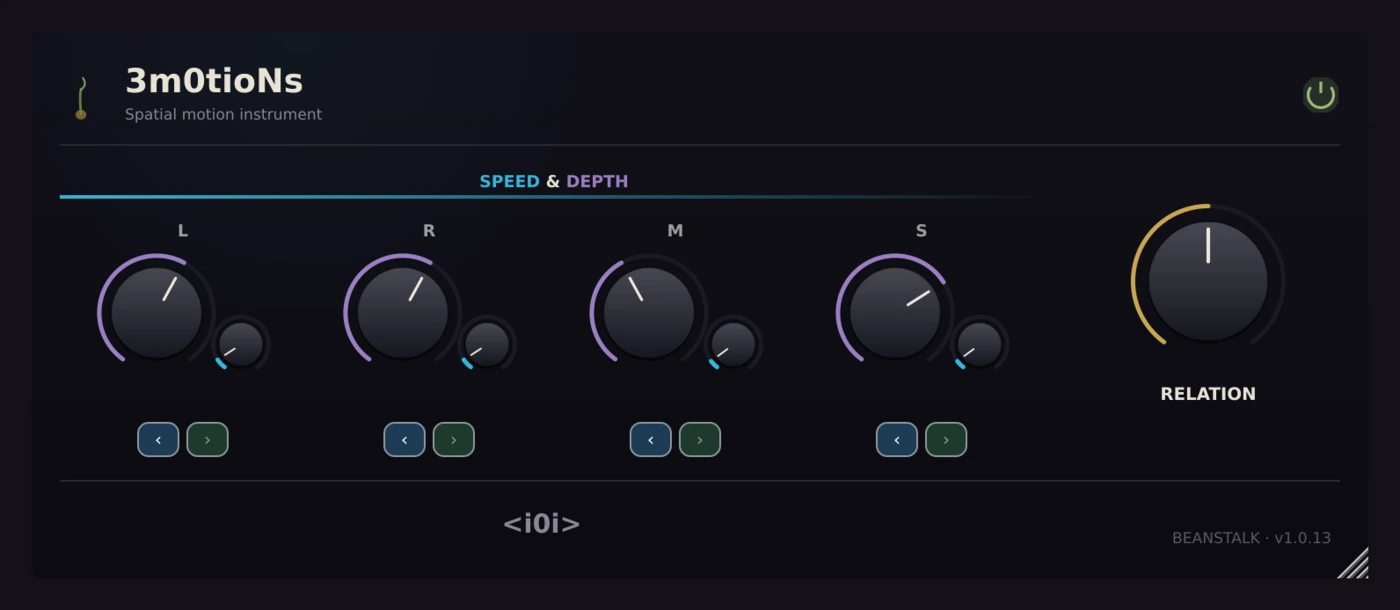
3m0tioNs uses the shared BeanStalk panel — near-black, a bean-sprout mark and the title top-left, a power light top-right — with cyan as its identity hue. The row the plugin is named for sits right under the header: for each channel, a large Depth knob with a smaller Speed knob at its bottom-right, and a ‹ › pair below it for Direction. Relation is the gold, centre-detented knob to the right. Clicking the sprout reveals live value readouts under every control.
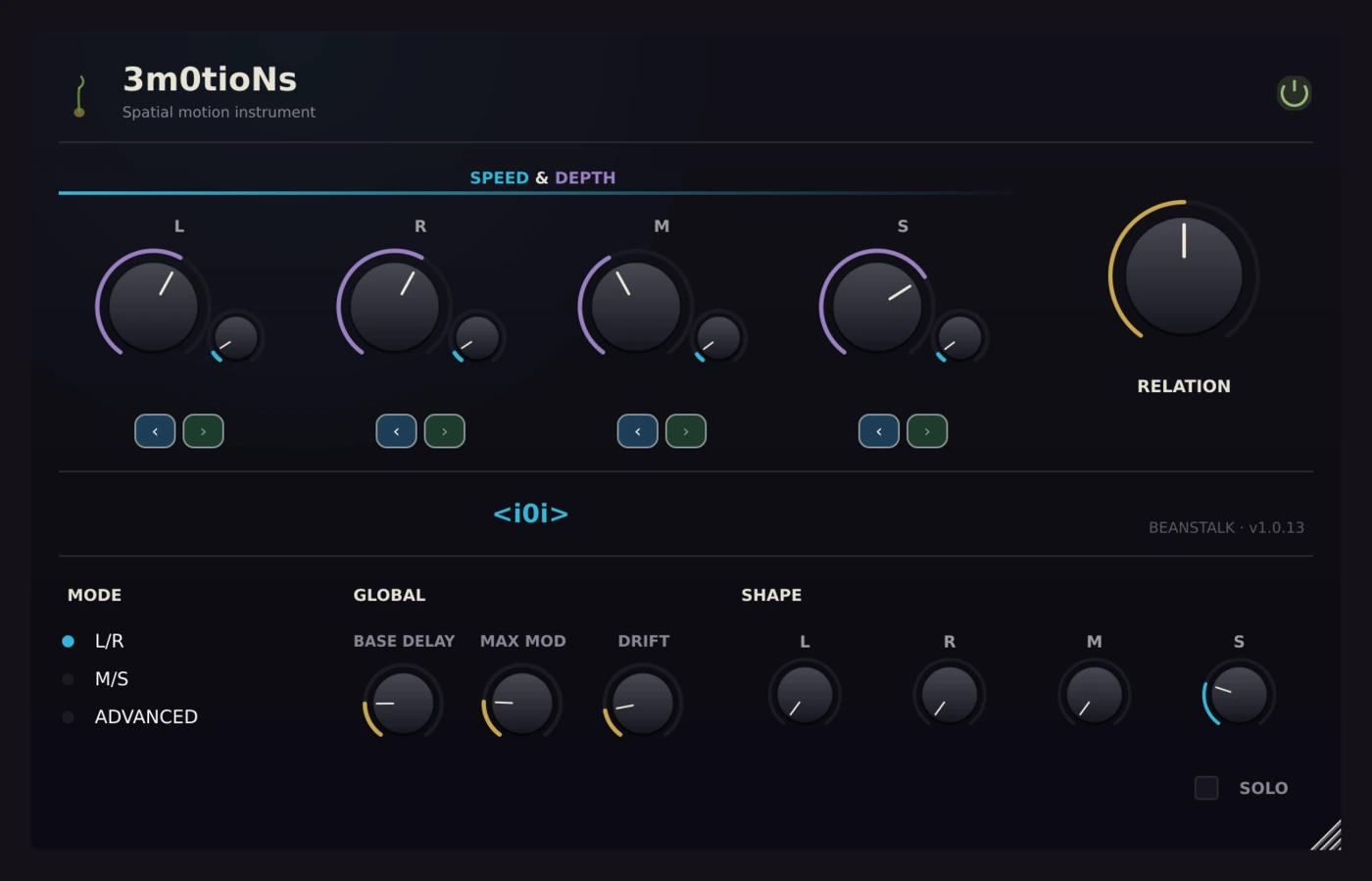
The <i0i> glyph in the footer opens a drawer that grows the window downward: Mode (L/R · M/S · Advanced — the L/R First / M/S First switch appears only in Advanced), the global Base Delay, Max Mod and Drift knobs, the four Shape selectors, and the Solo monitor toggle. The window is freely resizable and aspect-locked.
Where it earns its place.
A few things to know before you download
Read this before you buy.
Technical details and verified specs
Verified specifications.
Move it. Measure it. Listen to it.
3m0tioNs is pay-what-you-want with a $12 suggested price. VST3 and Standalone, Windows and Linux — more platforms may follow.
Get 3m0tioNs on GumroadDSP Lineage: The modulation behavior is inspired by Airwindows Flutter2. No Airwindows code is incorporated.