BeanStalk Plugin

l0fI

Lo-fi without the usual bitcrusher recipe. l0fI changes when pieces of the signal are kept or dropped, then lets you shape what gets left behind.

Temporal Resolution

Lo-fi by changing time.

Instead of simply lowering bit depth or sample rate, l0fI follows a repeating timing pattern to decide which parts of the signal pass through. The removed parts can become their own layer.

Get l0fI on Gumroad Pay what you want · free · VST3 + Standalone · Windows + Linux
l0fI
Built byBean.S.talk · BeanStalk Audio
StatusReleased · v1.0.0 · Windows + Linux — more platforms may follow
What is it?

So, what does it do?

l0fI makes sound feel less perfectly connected in time. It drops selected moments and lets you shape the pieces left behind for a lo-fi sound that isn't just bitcrushing.

Curious how it works?
The Concept

30fps and the edge of motion.

The premise behind l0fI: human vision reads roughly 30 frames per second as continuous motion, and anything slower starts feeling disconnected and dream-like. l0fI asks what the equivalent threshold sounds like for hearing — not by lowering fidelity, but by lowering how often reality is allowed to update, in a structure with a memory (Fibonacci) rather than random dropouts.

The DSP core (the scheduler, fold, retain/drop split, FADE and PAFNUTY2) is frozen and spec-locked. FastDistance, in the Advanced panel, is a separate, later addition: a subtle Airwindows-lineage conditioning/distance stage, not part of the core temporal engine.

Signal Path

What's retained goes straight through. What's dropped gets a second life.

The scheduler ticks every sample. A retain event passes the input straight to the sum; a drop event routes it into the residue stream — FADE, then PAFNUTY2 — which joins the same sum. RELATION blends that wet sum against dry (inverted-wet through wet, centre dry); FastDistance, in the Advanced panel, is the final, optional conditioning stage.

DRY — RELATION at 0% is exact dry; ±100% is inverted-wet ↔ wet IN SCHEDULER FIBONACCI or GOLDEN RATIO FOLD + UNRAVEL SPLIT RETAINED passes through FADE dissolve envelope PAFNUTY2 harmonic reincarnation SUM RELATION dry ↔ wet OUT via FastDistance GldnFiB — this ENTIRE chain runs twice at once, one Fibonacci-clocked and one Golden-Ratio-clocked, blended 50/50, before RELATION
SchedulerSample-accurate retain/drop clock. FIB sets the update rate; the interval between updates is a Fibonacci or Golden Ratio value, not a fixed divisor.
FoldThe ladder is walked up and back down rather than only getting sparser — a cycle, so the degradation breathes instead of ramping one way forever.
UnravelA deterministic, controlled chance for the fold to skip, repeat, jump, or reverse early. Zero is a perfectly intact fold; higher values make it occasionally lose its place.
Fade → Pafnuty2Dropped samples become a residue stream, not silence. Fade controls how abruptly that residue dissolves; Pafnuty2 turns part of the vanished energy into harmonics derived from it.
RelationBipolar: −100% is the exact polarity inversion of +100% wet, 0% is bit-exact dry. Default 0%.
FastDistanceAdvanced-panel-only. A subtle post-processing conditioning/distance stage, not a limiter and not true-peak protection. Factory default 10% / Post.
Controls

Six on the panel. Two more behind the badge.

FIB0–100%, default 35%How fast the temporal ladder updates — musically scaled from about 4 kHz down to 30 Hz. Zero is exactly transparent.
FOLD0–100%, default 20%How far up the Fibonacci ladder the fold travels before reversing — how deep the temporal sparsity gets before it cycles back.
UNRAVEL0–100%, default 10%Probability and reach of the fold's controlled disturbances. Zero keeps the fold perfectly deterministic.
FADE0–100%, default 20%How gradually dropped material dissolves — low is an abrupt digital fracture, high is a smeared temporal dissolve.
RELATION−100–+100%, default 0%The main-body dry/wet, sized larger than the four temporal knobs. Bipolar: centre is dry, the two directions are opposite polarities of wet.
SEQUENCEFibonacci / Golden Ratio / GldnFiBWhich ladder drives the scheduler — or, on GldnFiB, both complete engines at once, blended fixed 50/50 with no per-engine controls.
PAFNUTYAdvanced panel, 0–100%, default 50%How strongly the vanished residue is converted to harmonics. Zero leaves it as pure temporal residue with no harmonic content.
FASTDISTANCEAdvanced panel, 0–25% + Pre/Post, default 10% / PostA post-l0fI conditioning stage. There's no "Off" position — an amount of 0% is the hard bypass.
MASTER / CREATIVEAdvanced panel switchCreative is the full-range, normal-feel interface. Master re-maps the same knobs onto a honed musical sub-range with slower, more deliberate drag — same parameters, same automation, different feel.
The bean-sprout marktop-leftClick to reveal every numeric value readout at once. Dormant by default — plain bean, no numbers.
The <i0i> markfooter, dead centreOpens the Advanced band — PAFNUTY, FASTDISTANCE and MASTER/CREATIVE — by growing the same window, not a separate one.
BYPASSheader power lightTrue bypass — l0fI has zero processing latency anywhere in its chain, so bypass is bit-exact dry with no compensation needed.
A closer look at the controls
The Interface

Amber and dust. Part of the BeanStalk family.

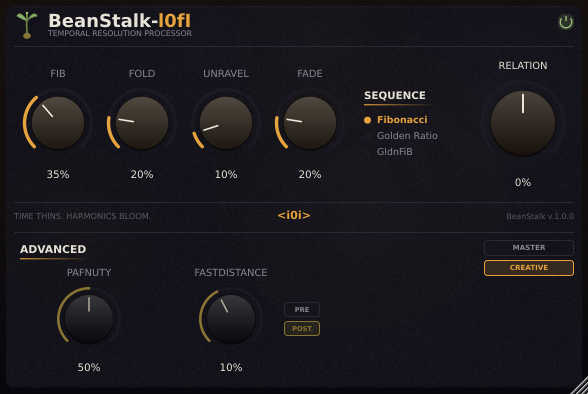
l0fI uses the shared BeanStalk vector panel with a dark, warm-leaning cast and an amber/dust identity — Fibonacci and the Golden Ratio both read "gold," so the plugin's whole colour language leans into that. The front panel carries the six primary controls; PAFNUTY, FASTDISTANCE and the MASTER/CREATIVE switch live in an Advanced band that opens from the same window rather than a separate one. Everything is drawn with vector primitives — no baked knob art, no skin images.
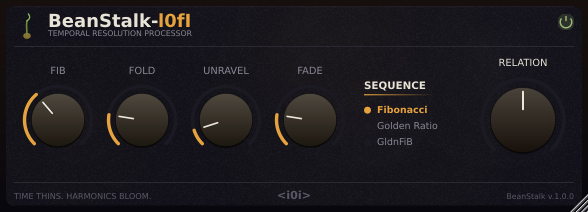
The BeanStalk-l0fI front panel: a compact near-black bar. Top-left a small bean mark; the title 'BeanStalk-l0fI' with 'l0fI' in amber and the subtitle 'TEMPORAL RESOLUTION PROCESSOR'. Top-right a small power light. FIB, FOLD, UNRAVEL and FADE knobs with amber value arcs, a SEQUENCE mode list showing Fibonacci selected, and a larger RELATION knob on the right. Footer: 'TIME THINS. HARMONICS BLOOM.', a centred '<i0i>' mark, and 'BeanStalk v.1.0.0'.
The front panel — FIB, FOLD, UNRAVEL, FADE, SEQUENCE and RELATION. Values hidden until the bean is clicked.
The BeanStalk-l0fI Advanced band, opened below the same front panel by growing the window taller rather than opening a separate one. Headed 'ADVANCED' with a thin amber underline. PAFNUTY and FASTDISTANCE knobs, Pre/Post pills beside the FastDistance knob with Post selected, and MASTER/CREATIVE pills top-right with Creative selected.
The Advanced band — PAFNUTY, FASTDISTANCE and MASTER/CREATIVE. Same window, same instance, just taller.
How to use it

Where it earns its place.

Dreamlike, disconnected texturesModerate FIB and FOLD, UNRAVEL low, RELATION toward full wet. The fold's cycle keeps the sparsity from just ramping into noise.
Harmonic "ghost" layersPush PAFNUTY up with FADE long, RELATION low so the harmonic residue sits under a mostly-dry signal rather than replacing it.
Controlled digital fractureFADE near zero for an abrupt, glitchy character instead of a smeared dissolve; UNRAVEL adds occasional structural surprises.
A stranger stereo imageGldnFiB blends the Fibonacci and Golden Ratio engines' complete outputs — two different temporal grids on the same input, summed.
Precision mix-bus useSwitch to MASTER in the Advanced panel: the same six knobs land in a honed range with slower drag, so small, repeatable moves are easy to land.
A/B against the sourceRELATION at 0% is exact dry; the header power light is a true, zero-latency bypass for a null reference.
A few things to know before you download
What it isn't

Read this before you download.

Not a bitcrusher or sample-rate reducerl0fI never touches bit depth or the host sample rate. The degradation is entirely about which samples get retained, not how coarsely they're quantised.
FastDistance is not a limiterThe Advanced-panel conditioning stage is a subtle Airwindows-lineage distance/darkening filter with no notion of "how far over" a signal is — it will not rescue an already-hot master.
GldnFiB has no per-engine controlsThe 50/50 blend between the Fibonacci and Golden Ratio engines is fixed and is part of the character — there's no balance knob, by design.
TILT isn't exposedAn internal Pafnuty2 tilt mechanism exists in the DSP for architectural reasons but is locked at its centre value and isn't a user control in this release.
Technical details and verified specs
Technical

Verified specifications.

FormatsVST3 · Standalone application
Operating systemsWindows 10/11 (64-bit) · Linux (64-bit)
ChannelsMono or stereo, matched in/out
Latency0 samples — no lookahead anywhere in the chain
Sample ratesAny host rate; schedule timing verified consistent at 44.1 / 48 / 96 kHz
BypassHeader power light — bit-exact dry, no latency compensation needed
DSP coreFrozen per the plugin's own 24-section spec: scheduler, fold, retain/drop split, Fade and Pafnuty2 are unmodified from their validated milestone builds
GldnFiBTwo complete, independent engine instances, fixed 50/50 blend, no per-engine gain
AutomationAll six panel parameters plus PAFNUTY, FastDistance amount/position and Bypass are host-automatable; Master/Creative is a GUI interaction mode, not a parameter
Version1.0.0

Time thins. Harmonics bloom.

l0fI is pay-what-you-want, and free is a fair price. VST3 and Standalone, Windows and Linux — more platforms may follow.

Get l0fI on Gumroad

DSP Lineage & Attribution: This plugin incorporates adapted DSP components from Airwindows (Chris Johnson, MIT licensed): FastDistance and Pafnuty2. The specific components and applicable notices are documented in the included THIRD_PARTY_NOTICES.md. This does not imply endorsement by or affiliation with Airwindows.

More BeanStalk plugins

See all plugins →