BeanStalk Plugin

0bysS

A delay that keeps digging long after the obvious echoes are gone. 0bysS brings those deep, buried repeats forward so you can shape the space behind your sound.

Recursive Texture / Deep Field

Past the last echo.

Most delays fade away after a few repeats. 0bysS keeps following the feedback much further, then lets you hear and shape the quieter layers that would usually disappear.

Get 0bysS on Gumroad Pay what you want · $18 suggested · VST3 + Standalone · Windows + Linux
DEEP
Built byBean.S.talk · BeanStalk Audio
StatusReleased · v2.1.0 · Windows + Linux — more platforms may follow
What is it?

So, what does it do?

Most delays get quieter until the repeats disappear. 0bysS lets you explore the deep echoes that are usually left behind. Bring them forward, shape them, and see where they take the sound.

Curious how it works?
The Concept

Everyone else stops at the noise floor. 0bysS starts there.

Ordinary delay design treats deep feedback generations as a problem to manage — keep them quiet, keep them out of the way, eventually cut them off. 0bysS's premise is that generations 15–40 aren't garbage, they're a genuinely different kind of material: fully decorrelated, near-mono, and — at high Decay — barely quieter than the generations right above them.

That's measured, not asserted: at Decay 0.999 the spread from generation 15 to generation 40 is 0.4 dB. The whole exposed range is close to one level. Below a certain Decay, the deep generations do fall away — but cleanly, down to silence, never into noise-floor garbage. There's no generation in the 15–40 window that's dead weight you have to avoid; the interface exposes exactly that window because that's exactly where the useful field lives.

G15 G40 0 dB −4 dB decay 0.999 — 0.4 dB spread across G15→G40 lower decay — falls away smoothly, never into noise
Signal Path

One field, weighted, compensated, then blended.

The Recursive cascade runs hidden generations 1–14 as scaffolding — they're never summed, only used to compute what comes after. Generations 15 through REACH are the exposed field. Everything downstream of that field is deliberate shaping; the dry signal never touches any of it until the final RelatioN blend.

DRY — bit-untouched, blended by RelatioN, then scaled by Trim IN STEREO FR0CT RECURSIVE ENGINE hidden G1–14 scaffolding · never summed field = G15 … REACH, summed DEPTH per-gen weight, level-preserving PRIMER +9 fixed, internal, wet-only DECAY COMP internal · unity ≥ 0.97 only ever boosts GAIN user, −12…+36 dB RELATION dry/wet blend SOLO = wet only TRIM ±18 dB, final OUT
The fieldGenerations 15 through REACH are summed into one signal, each weighted by DEPTH (mean-normalised, so overall level is preserved as DEPTH moves — 0 is exactly neutral for every generation).
Primer & decay compensationA fixed internal +9 boost and an internal decay-compensation stage (unity at Decay ≥ 0.97, only ever boosts, never pumps — one scalar per block) keep DECAY's whole 0.85–0.999 travel level-stable, so the knob changes character, not loudness.
Gain, then the blendUser GAIN sets the wet field's level before RELATION blends it against the completely untouched dry signal. SOLO isolates the wet contribution alone for monitoring.
Trim is lastTRIM scales the already-blended dry+wet signal as one, for matching output level against bypass. BYPASS returns dry before any of this runs — true DSP bypass, not Relation at 0.
Controls

Five on the face. RelatioN beside them. A drawer for the rest.

TIME0.01–50 ms, default 15The first delay-time seed the whole recursive cascade grows from. Small changes here compound over 40 generations into very different textures.
DECAY0.85–0.999, default 0.97How far the tail sustains, generation to generation. Internal compensation holds the level roughly constant across the whole travel (~2 dB spread) so this changes the field's character, not its volume.
DEPTH−1…+1, default 0Moves emphasis within the field: negative leans toward the shallow end (closer to G15), positive toward the deep end (closer to REACH). Level-preserving — 0 is exactly neutral.
FOLD0–1, default 0Folds the delay-time sequence back on itself, adding a second layer of self-reference on top of the recursion. Interacts with TIMING — see the LAB drawer.
REACH15–40, default 40How deep into the field the exposed range goes. No generation in this range is dead weight — REACH is a "how much of the whole field" control, not a quality dial. Re-levels the field slightly (~0.8 dB across 20–40); Gain covers it.
ENERGY (Gain)−12…+36 dB, default 0Output level on the wet field, before the RelatioN blend. The range was set from measurement — the quietest realistic setting can reach a useful level without an extreme correction.
RELATION0–100%, default 100%Dry/wet blend, bit-exact dry at 0%. In MASTER mode the knob's travel is curated to a safe, musical sub-range for the current TIMING/FOLD combination; in CREATIVE it's the full 0–100%.
TRIM±18 dB, default 0The final output stage, applied after the RelatioN blend — scales the whole combined signal, for matching level against the bypassed signal. Centre-detented at 0 dB (unity).
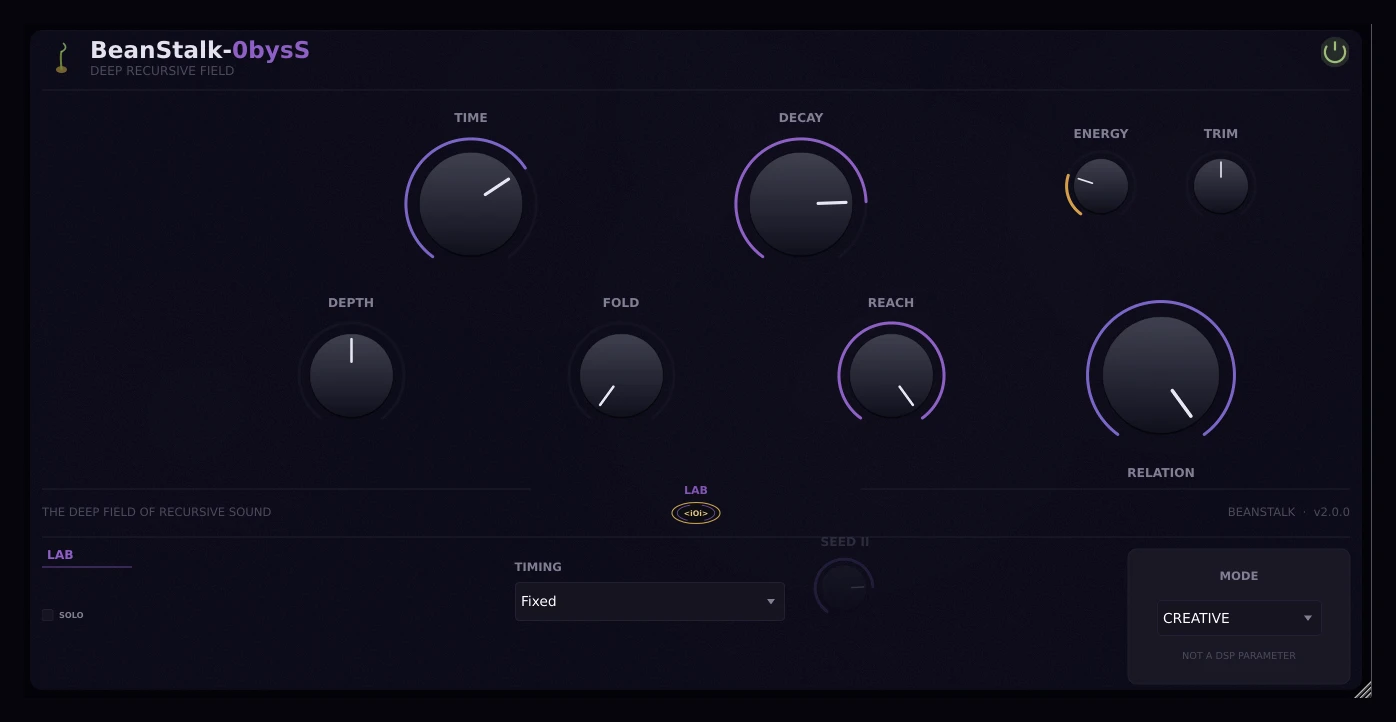
The LAB drawer<iOi> badge — off by defaultTIMING (Fibonacci / Golden Ratio / Fixed, default Fixed), SEED II (the second delay-time seed, only meaningful under Fibonacci), SOLO (monitor the wet field alone), and MODE (MASTER / CREATIVE — see Controls above).
BYPASSheader toggleTrue DSP bypass — the recursive cascade doesn't run at all, not merely a RelatioN-at-0 blend.
A closer look at the controls
The Interface

Deep violet, orchid accents. Part of the BeanStalk family.

0bysS uses the shared BeanStalk panel with its own cool, blue-violet cast — the deepest, darkest identity in the lineup, appropriate for a plugin about the part of a cascade nobody else exposes. TIME and DECAY lead the top row with ENERGY and TRIM alongside; DEPTH, FOLD and REACH sit below. RELATION is the largest knob on the panel, set apart on the right. The <iOi> badge opens the LAB drawer below for TIMING, SEED II, SOLO, and the MODE control (MASTER/CREATIVE) in its own well.
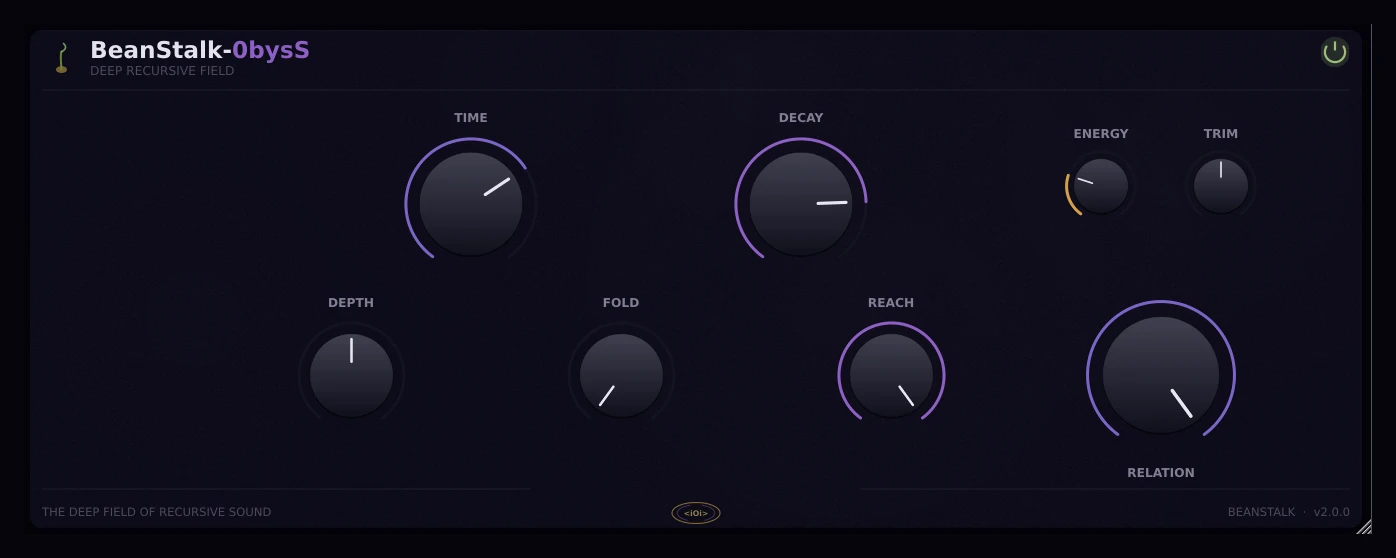
The BeanStalk-0bysS plugin interface, default view: a wide near-black panel with a cool blue-violet cast. Top-left a bean-sprout mark, the title 'BeanStalk-0bysS' in cream with '0bysS' in orchid, and the subtitle 'DEEP RECURSIVE FIELD'; a green power light top-right. A top row of knobs: TIME and DECAY with violet arcs, then ENERGY with a gold arc and TRIM, smaller, on the right. Below: DEPTH, FOLD and REACH with violet arcs, and a large RELATION knob set apart on the right with a bold violet arc. The footer reads 'THE DEEP FIELD OF RECURSIVE SOUND' on the left, a small gold <iOi> lab badge centred, and 'BEANSTALK · v2.0.0' on the right.
Default view — TIME, DECAY, ENERGY and TRIM on top; DEPTH, FOLD, REACH and the enlarged RELATION knob below.
The 0bysS interface with the LAB drawer open beneath the main panel: a TIMING dropdown set to Fixed, a greyed SEED II knob beside it (only active under Fibonacci timing), a SOLO checkbox at the lower left, and a MODE well on the right holding a MASTER/CREATIVE dropdown currently set to CREATIVE, labelled 'NOT A DSP PARAMETER'.
The LAB drawer — TIMING, SEED II (greyed under Fixed timing), SOLO, and the MASTER/CREATIVE MODE control.
How to use it

Where it earns its place.

A texture bed under a mixLow RelatioN, high Decay, default Reach: a smooth, decorrelated wash sitting far under a full mix — thickness and space with nothing identifiable as "a delay."
Extreme send returnOn a return track at full RelatioN with FOLD and high DEPTH toward the deep end: a genuinely unfamiliar recursive texture for transitions, drones and sound design.
Slow-evolving padsSustained synth or guitar pad, moderate Decay, DEPTH toward the shallow end: adds body and reach without the wash swallowing the note's attack.
Percussive material, low RelatioNOn drums or plucked sources, keep RelatioN low and REACH modest — the field is decorrelated and near-mono, so it reads as ambience rather than a rhythmic echo.
Curated exploration (MASTER)Leave MODE on MASTER and just turn RelatioN — the knob's whole travel is a musically safe range for whatever TIMING/FOLD you're on, so you can't accidentally dial in an extreme blend.
Full-range sound design (CREATIVE)Switch MODE to CREATIVE for the complete 0–100% RelatioN range — useful once you know the territory and want the extremes MASTER curates away.
A few things to know before you download
What it isn't

Read this before you buy.

Not a conventional delayThere are no discrete, countable repeats to hear. Generations 15–40 are summed into one field — you can't isolate "the third echo."
Not a reverbThe field is near-mono and decorrelated by design, not a spatial simulation. It doesn't model a room.
Not spatially wideThe recursive field measures 50+ dB below Mid in Side energy — a G/P-style stereo control was tested and cut because there's no meaningful stereo information here to control. Width comes from elsewhere in your mix.
Can exceed 0 dBFS on the wet fieldThe wet path is not internally limited. At extreme settings — very short TIME with FOLD engaged especially — the field can peak hot. Watch your gain staging; this is documented, measured behaviour, not a bug.
Technical details and verified specs
Technical

Verified specifications.

FormatsVST3 · Standalone application
Operating systemsWindows 10/11 (64-bit) · Linux (64-bit)
EditionsBeanStalk-0bysS (default vector GUI) and BeanStalk-0bysS Explorer (photoreal faceplate). Same DSP core, same VST3 identity — presets round-trip between them.
ChannelsStereo in / stereo out. The recursive field is near-mono by design (not a stereo effect).
LatencyA constant 23 samples at 44.1 and 48 kHz (39 at 96 kHz), always reported to your host, whether the optional Safety is on or off. The recursive cascade's own delay-line time constants are part of the sound, not extra reported latency.
Sample ratesAny host rate
HeadroomNo limiter on the wet field by default. Extreme settings (short TIME, FOLD on) can exceed 0 dBFS. New in 2.1.0: an optional, off-by-default micr0.pkZ Safety stage after Trim (parameters Safety, Safety Ceiling −12 to −0.1 dB, Safety Release; no on-screen control yet, set it from your host's parameter list). It guards sample peaks, not true peaks.
BypassTrue DSP bypass — the cascade does not run; the dry signal passes unchanged, delayed by the reported latency so your host stays aligned. RelatioN at 0% is also silent-of-effect (Trim still applies at 0%).
CPUOne recursive cascade to generation 40, decay compensation and level shaping. No published percentage.
Version2.1.0

The field doesn't end where other delays give up.

0bysS is pay-what-you-want with an $18 suggested price. VST3 and Standalone, Windows and Linux — more platforms may follow.

Get 0bysS on Gumroad

DSP Lineage & Attribution: This plugin incorporates adapted DSP components from Airwindows (Chris Johnson, MIT licensed): BitShiftGain. The specific components and applicable notices are documented in the included THIRD_PARTY_NOTICES.md. This does not imply endorsement by or affiliation with Airwindows.

More BeanStalk plugins

See all plugins →