BeanStalk Plugin

Lat0taL

Take part of the signal away, then scatter what remains through two delay spirals. It's a space effect built from subtraction first.

Spatial Texture / Phase Cancellation

Remove. Scatter. Listen.

Lat0taL subtracts a shaped copy of the sound from itself. The difference feeds a set of delays, creating movement and space from material that was taken away.

Get Lat0taL on Gumroad Pay what you want · $10 suggested · VST3 + Standalone · Windows + Linux
SPIRAL
Built byBean.S.talk · BeanStalk Audio
StatusReleased · v0.3.0 · Windows + Linux — more platforms may follow
What is it?

So, what does it do?

Lat0taL takes a shaped piece away from the sound and sends what remains through moving delays. The result can be roomy, strange, or beautifully unsettled.

Curious how it works?
The Concept

Two ratios that never agree.

The Fibonacci sequence (1, 2, 3, 5, 8) and the golden ratio (φ ≈ 1.618, then φ², φ³…) are related — Fibonacci ratios converge toward φ — but they're never equal. Lat0taL uses that gap on purpose. Branch A's spiral places its five taps at the integer Fibonacci multiples of the base time; branch B's places them at the continuous golden-ratio powers. Feed the same source into both and the two tap sets drift past each other, producing a comb structure that keeps evolving instead of settling into a fixed timbre.

Neither spiral has feedback, normalization or modulation — they're plain interpolated delay reads. All the movement comes from the geometry and from where the dissolver has carved the signal. Spiral Time scales both spirals together from 1 ms (dense, almost a resonance) up to 50 ms (discrete, flam-like).

The pole positions inside each dissolver are fixed internal constants, set by ear during development rather than exposed as knobs — sensitivity testing showed they matter far less than Character, Dissolve and Spiral Time. The two dissolver outputs are a literal sum, not an average, so the dry signal is present twice at neutral settings by construction. That's intentional; Trim is there to set the level you actually want.

Signal Path

Cancel twice, scatter twice, sum once.

Two identical dissolver branches run on the same input. Each subtracts a filtered copy of the signal from itself and sends what it removed to its own delay spiral. The two dissolved signals sum; the two spiral fields sum and are blended back by Relation; safety filters and Trim close the chain.

CANCELLED SIGNAL → FIBONACCI SPIRAL CANCELLED SIGNAL → GOLDEN SPIRAL SPATIAL MODE mutes one, both or neither IN STEREO DISSOLVER A — TILT 1–8 POLE CASCADE · CHARACTER DISSOLVER B — TILT 1–8 POLE CASCADE · CHARACTER x − cancel cancel = tilt·DISSOLVE x − cancel cancel = tilt·DISSOLVE mainOut A + mainOut B literal sum — dry doubles SOLO mutes this FIB SPIRAL D×1,2,3,5,8 GOLDEN SPIRAL D×φ⁰…φ⁴ SPIRAL FIELD SUM 5 + 5 interpolated taps · no feedback RELATION −INV · BP · +WET GUARDS 20 Hz HP · 19 kHz LP · fixed TRIM ±12 dB · last OUT DRY — host Bypass returns this untouched (Relation at BP is silent-of-spiral, not a full bypass — the dissolvers still run)
The dissolverA fractional 1–8-pole cascade (fixed 1 kHz corner) tilted between its low and high halves by Character, scaled by Dissolve, and subtracted from dry. A phase-cancellation carve you move, not an EQ band you boost or cut.
Two spirals, two ratiosBranch A's cancelled signal feeds taps at the Fibonacci multiples (1, 2, 3, 5, 8) of Spiral Time; branch B's feeds taps at powers of φ. The spacings never coincide, so Both mode scatters without repeating.
Relation is bipolarPositive folds the spiral field in as-is; negative inverts it (a second cancellation layer); the centre position (BP) is exactly silent. It is not a dry/wet — the dissolved sum is always present unless Solo is on.
Sum, not averagemainOut A + mainOut B is a literal add — the dry signal is present twice at neutral settings, by construction. Expect roughly +6 dB versus the input before you touch anything; Trim sets the level you want.
Guards, then TrimA fixed 20 Hz high-pass and 19 kHz low-pass catch sub-rumble and ultrasonic content — frequency only, never level or dynamics. Trim is the very last thing in the chain, after the guards.
Bypass vs. Relation BPHost Bypass returns the untouched dry input — a true clean bypass, no DSP runs. Relation at BP only silences the spiral field; the dissolvers, the doubled dry sum, the guards and Trim all still run.
Controls

Six knobs. No menus, no drawer.

CHARACTER0–100%, default 50%Where the dissolver carves. Toward 0% it cancels more of the low half of the filtered signal; toward 100%, more of the high half. It sets the tonal centre of the phase-cancellation notch and, through the spirals, the colour of the scatter.
DISSOLVE0–100%, default 50%How much is subtracted. At 0% nothing is cancelled (dry passes, doubled); as you raise it the notch deepens and more signal is diverted into the spirals. High settings can hollow the source out substantially.
SPIRAL TIME1–50 ms, default 1 msThe base delay both spirals scale from. Around 1 ms the taps pack into a resonant, metallic comb; toward 50 ms they separate into distinct short repeats and flams. Every other tap time is this value times a fixed ratio.
RELATION−100% INV … BP … +100% WET, default BPBipolar spiral-field mix. Right (WET) adds the scatter; left (INV) adds it phase-inverted, which cancels differently again; centre (BP) is silent. Not a dry/wet — the dissolved signal is always there underneath.
SPATIAL MODEFibonacci / Both / Golden, default BothWhich spiral reaches the output. Fibonacci alone is more periodic and focused; Golden alone is looser; Both is the dense, non-repeating scatter the plugin is built around.
TRIM−12…+12 dB, default 0 dBA plain output level, applied dead last — after the safety guards, right before the signal leaves. It's a level knob, not automatic make-up gain; use it to deal with the doubled-dry sum and heavy Dissolve settings.
SOLOpanel toggleMutes the dissolved sum so you hear only the combined spiral field — useful for dialling in Spiral Time and Spatial Mode before blending back with Relation.
The bean-sprout marktop-leftToggles the numeric value readouts under every knob on and off. The panel grows slightly taller to make room when they're shown.
BYPASSheader power lightTrue clean bypass — the host holds the dry signal and no part of the DSP runs, not even the safety guards.
A closer look at the controls
The Interface

Spiral coral on near-black. Part of the BeanStalk family.

Lat0taL uses the shared BeanStalk vector panel — one compact, aspect-locked, resizable surface, no drawers. CHARACTER leads on the left with a coral value arc; DISSOLVE, SPIRAL TIME, RELATION and the smaller TRIM follow across the row. SPATIAL MODE is a dot column on the right with SOLO beneath it. The bean-sprout mark top-left toggles the value readouts; the power light top-right is the bypass indicator. Everything is drawn with vector primitives — no baked knob art, no skin images.
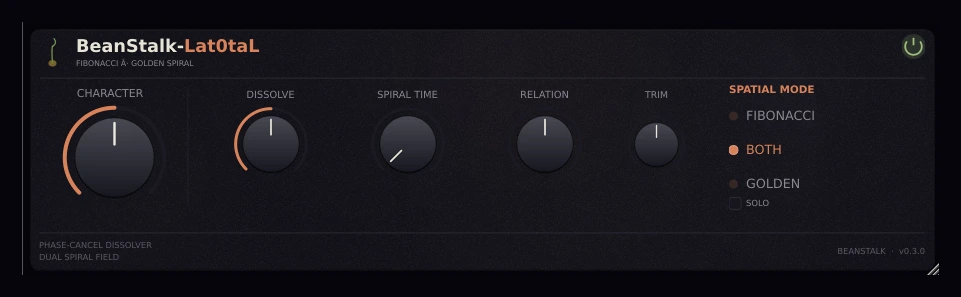
The BeanStalk-Lat0taL interface: a wide, short near-black panel. Top-left a small gold bean-sprout mark, the title 'BeanStalk-Lat0taL' with 'Lat0taL' in coral and the subtitle 'FIBONACCI · GOLDEN SPIRAL'; a green power light top-right. A row of knobs left to right: a large CHARACTER knob with a coral value arc, then DISSOLVE (also coral arc), SPIRAL TIME, RELATION, and a smaller TRIM. On the right, a coral 'SPATIAL MODE' label above three radio dots — FIBONACCI, BOTH (selected, coral), GOLDEN — with a SOLO checkbox below. The footer reads 'PHASE-CANCEL DISSOLVER / DUAL SPIRAL FIELD' on the left and 'BEANSTALK · v0.3.0' on the right.
The full interface — CHARACTER, DISSOLVE, SPIRAL TIME, RELATION and TRIM across the row; SPATIAL MODE and SOLO on the right.
How to use it

Where it earns its place.

Metallic resonant bedsSpiral Time near 1 ms, Both mode, moderate Dissolve, Relation toward WET. The packed taps form a tuned comb that tracks the source — good under drones, pads and sustained tones.
Short scattered ambienceSpiral Time 15–35 ms, Golden or Both, low Relation. Discrete early-reflection-like repeats with no two spacings alike — a room that isn't a room.
Hollowing a source outHigh Dissolve, Solo off, Relation near BP. The dissolver carve becomes the effect: a phase-cancelled, thinned version of the input with the removed band audible only as spiral scatter.
Inverted-tail weirdnessRelation toward INV. The spiral field folds back phase-inverted, cancelling against the dissolved sum in a way that shifts as you move Character and Spiral Time.
Sound design layersSolo on, automate Spiral Time and Spatial Mode. Monitoring the spiral field alone turns Lat0taL into a generator of evolving metallic and granular textures.
Subtle width on a busLow Dissolve, Spiral Time ~8–12 ms, Both, Relation just past BP. A small amount of incommensurate scatter widens and de-correlates without an obvious effect.
A few things to know before you download
What it isn't

Read this before you buy.

Not a reverbNo feedback, no diffusion network, no room model. The spirals are ten fixed interpolated taps, total — the density comes from geometry, not from a decay algorithm.
Not a tempo-synced delaySpiral Time is milliseconds, not note values, and the taps are ratio-spaced. There's no host sync and no intent to lock to a groove — the point is that the two spacings don't line up.
Relation at centre is not bypassBP silences the spiral field only. The two dissolvers, the doubled dry sum, the safety guards and Trim all keep running. Use the host's Bypass for a true dry reference.
No level protectionThere are no meters, no limiter, no auto-gain — only the fixed 20 Hz / 19 kHz frequency guards. The doubled-dry sum plus heavy Dissolve or WET Relation can get loud; watch Trim and your gain staging.
Technical details and verified specs
Technical

Verified specifications.

FormatsVST3 · Standalone application
Operating systemsWindows 10/11 (64-bit) · Linux (64-bit)
ChannelsStereo in / stereo out only
LatencyNone reported. The spiral delay reads are part of the effect, not reported plugin latency.
Sample ratesAny host rate; validated 44.1 / 48 / 88.2 / 96 / 176.4 / 192 kHz
Parameter smoothingNone — parameters are read once per block and held (matches the plugin's original design exactly).
Safety filtersFixed 20 Hz high-pass (2-stage) + 19 kHz low-pass (4-stage), frequency content only. No limiter, no dynamics processing, no auto-gain.
BypassTrue clean bypass — the host holds the dry signal, no DSP runs.
LevelThe two dissolver outputs are summed, not averaged — dry is present twice at neutral (~+6 dB vs. input). Trim is the user level control.
CPUTwo 8-pole cascades plus ten interpolated delay taps. No published percentage.
Version0.3.0

Two geometries, one signal, no repeat.

Lat0taL is pay-what-you-want with a $10 suggested price. VST3 and Standalone, Windows and Linux — more platforms may follow.

Get Lat0taL on Gumroad

More BeanStalk plugins

See all plugins →