BeanStalk Plugin

p0rtalS

Harmonics that respond to how the music moves, not just how loud it gets. Shape the body, punch, and detail separately.

Harmonic Field / Spatial

Follow the playing, not just the level.

p0rtalS watches three regions of the sound for changes in musical activity. Those readings guide the harmonics it adds, so the effect can respond differently to different material.

Get p0rtalS on Gumroad Pay what you want · $20 suggested · VST3 + Standalone · Windows + Linux
PORT
Built byBean.S.talk · BeanStalk Audio
StatusReleased · v0.1.33 · Windows + Linux — more platforms may follow
What is it?

So, what does it do?

p0rtalS pays attention to how the music moves, not just how loud it is. It uses that movement to grow new harmonics that can add body, punch, or detail.

Curious how it works?
The Concept

Ground and Tesla — one field, two behaviours.

The harmonic field has two halves. Ground is the near field — even-leaning orders 2/4/5/7/8 — and it tracks the source closely, sitting right on top of it like extra body and edge. Tesla is the far field — the 3/6/9 family and its multiples 12/15/18, chosen as one perceptual structure (3×1, 3×2, 3×3) rather than three tuned bands — and it drifts, reading as an increasingly independent shape orbiting the sound. The Fun/Tesla knob crossfades between them; Distance throws the whole thing further out in time.
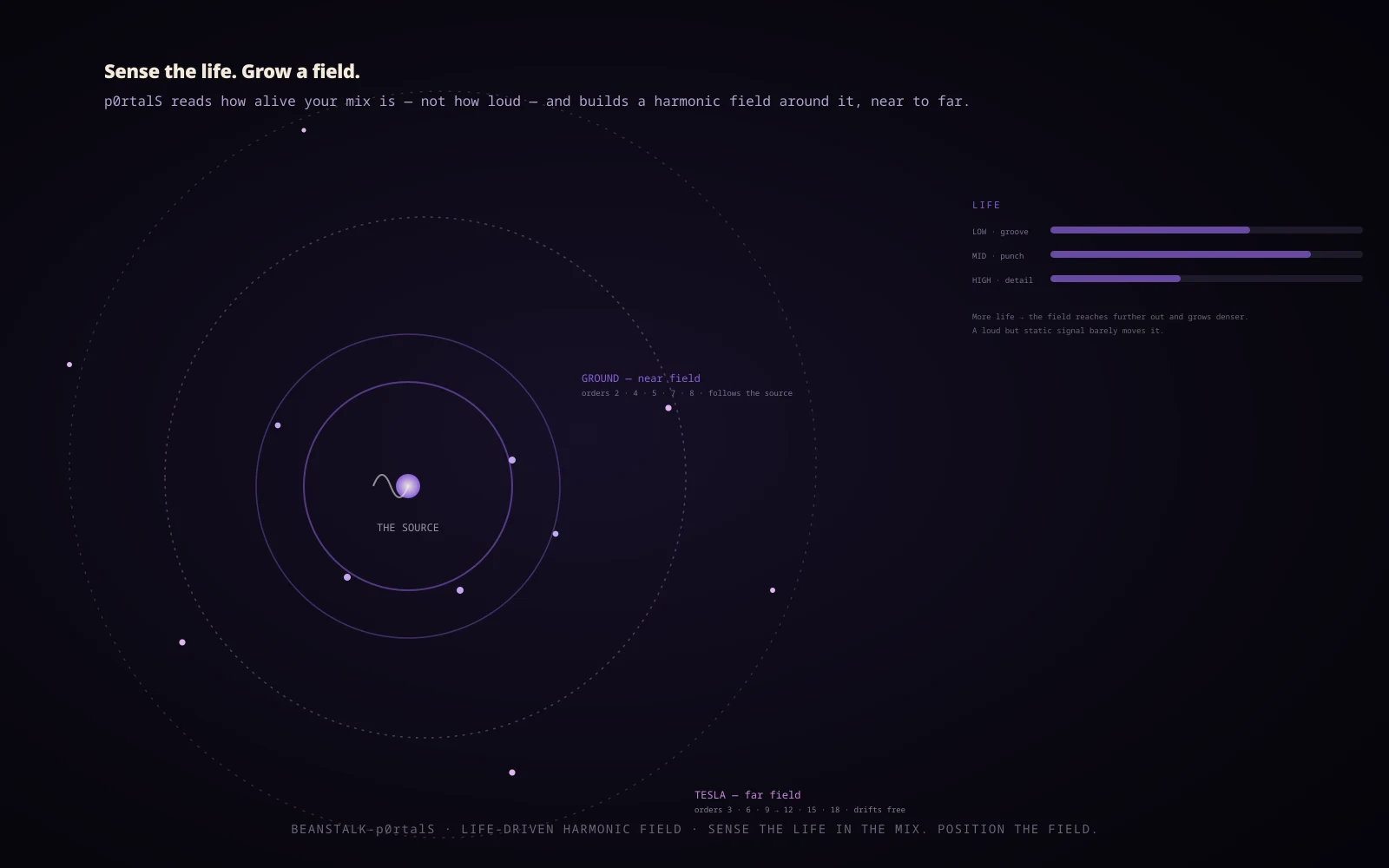
Diagram: a bright central source with a harmonic field radiating outward. Solid violet rings close to the source are labelled GROUND (near field, orders 2·4·5·7·8, follows the source); dashed violet rings further out are labelled TESLA (far field, orders 3·6·9 to 12·15·18, drifts free). Harmonic nodes are scattered along the rings. A LIFE panel to the side shows LOW/MID/HIGH meter bars, with a note that more life makes the field reach further and grow denser while a loud-but-static signal barely moves it.
More life pushes the field further out and denser. A loud but static signal barely moves it.
Signal Path

The analysis never touches the audio.

A separate life reading steers how the harmonic field behaves — near or far, how tilted, how much reach, how deep the micro-delay throw — while the signal Tesla actually generates from never passes through the analysis path at all. The dry signal is left completely alone and blended back at the end.

GROOVE / PUNCH / DETAIL — STEERS THE FIELD & THE THROW DISTANCE × LIFE × REACH DRIVE BOOSTS ANALYSIS ONLY, THEN CANCELS BACK OUT IN STEREO TESLA FIELD NEAR 2,4,5,7,8 · FAR 3,6,9,12,15,18 SEPARATION ~4ms EXPANSION ~9ms FAR FIELD ~20ms ULTRASONIC FIXED, ALWAYS ON DRIVE COMP INVERSE-GAIN CANCEL BLEND += DRY OUT DETECTOR DRIVE 0–24 dB, ANALYSIS COPY LIFEBAND SPLITTER <150 / 150–3k / >3k Hz · slew+peak+baseline DISTANCE KNOB × LIFE × REACH CONTROL PATH — CARRIES NO AUDIO
LifeBand AnalysisA mono-summed copy of the input is split into LOW (<150 Hz, groove/body), MID (150 Hz–3 kHz, punch/action) and HIGH (>3 kHz, air/detail) via Linkwitz-Riley crossovers, each measured for slew, peak and baseline — a broad perceptual read, not fundamental tracking.
Tesla Harmonic FieldNear orders (2, 4, 5, 7, 8) and far orders (3, 6, 9, 12, 15, 18) are generated via the Chebyshev recurrence directly from the real L/R signal — per channel, which also lets the field open up in stereo as it's pushed. The Life reading steers the blend and tilt, never the harmonic math.
Three-Stage Micro-DelaySeparation (~4 ms), Expansion (~9 ms) and Far Field (~20 ms) cascade in sequence, all riding one Distance control that's itself multiplied by how alive the signal is and how far the harmonics reach — a deliberate "don't over-knob" choice.
Cancelling Its Own BoostDetector Drive boosts only the copy the analyzer hears; a paired inverse-gain stage cancels the resulting extra harmonic energy right before the wet field rejoins dry, so the knob changes reactivity without changing level.
Controls

Five on the face. A drawer for the rest.

Fun / Tesla0 – 1, default 0.5Equal-power crossfade between the near Ground field (follows the source, sits on top of it) and the far Tesla field (the 3/6/9 family, drifts free). Toward Fun it's an exciter that hugs the sound; toward Tesla it's a shape that orbits it.
Blend0 – 1, default 0.35How much of the wet harmonic field is added on top of the untouched dry signal. The dry is never scaled — Blend only adds — so at 0 the plugin is silent-of-effect.
Distance0 – 1, default 0A ceiling on how far the field is thrown in time through the three micro-delay stages. How much of that ceiling is actually used tracks the harmonic reach and the overall Life right now, so a still passage keeps the field close and a busy one lets it travel.
Order Tilt−1 to +1, default 0Reshapes the harmonic-order weighting inside both fields — toward the low orders for a rounder, denser body, toward the high orders for more air and sparkle in the reach.
Detector Drive0 – 24 dB slider, default 0Boosts only the signal the Life detector hears, so quiet or gentle material still reads as alive and the field still responds. Inverse-compensated on the wet path — it changes how reactive p0rtalS is, not how loud.
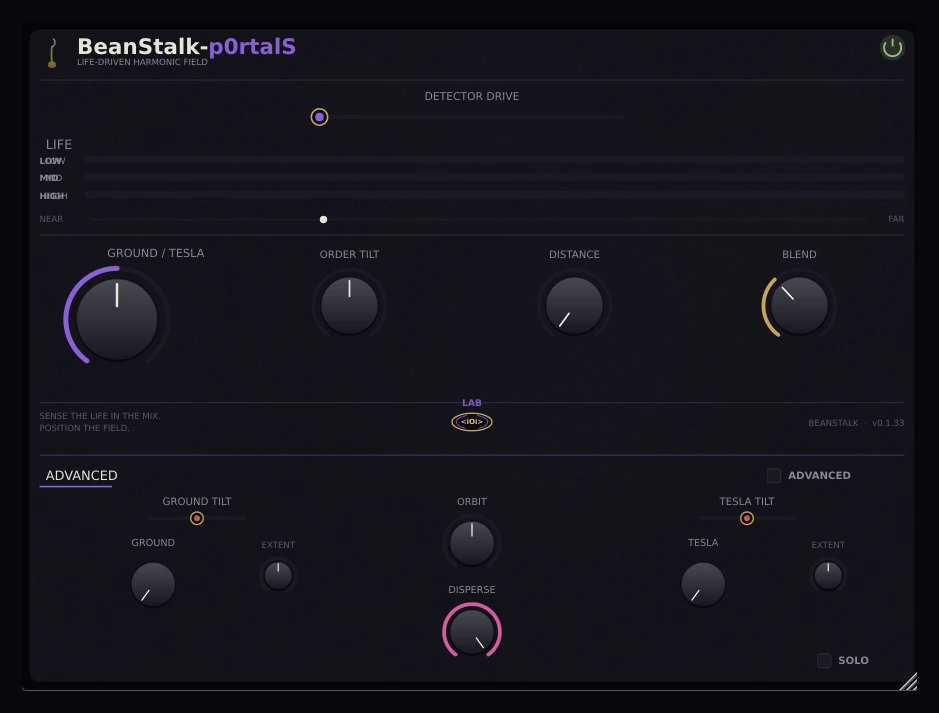
The LAB drawer<iOi> badge — off by defaultAn ADVANCED toggle unlocks independent Ground / Tesla presence, separate per-field Order Tilt and Extent (stereo width per field), a pitch-shadow chain — Orbit (±24 semitones between the shadow engines) and Disperse (0–8, spread) — and Solo, which monitors the wet field alone.

The LIFE meter (LOW / MID / HIGH bars and a NEAR‥FAR strip) is diagnostic only — it reads lock-free values on a UI timer and never touches audio.

A closer look at the controls
The Interface

A meter you can read, and knobs that follow it.

Detector Drive is a slider across the top; the LIFE meter sits under it — three band bars plus a NEAR‥FAR field-distance strip — then the main knob row: Ground/Tesla, Order Tilt, Distance, Blend. The <iOi> badge opens the LAB drawer. Part of the BeanStalk family visual system; p0rtalS's identity hue is violet.
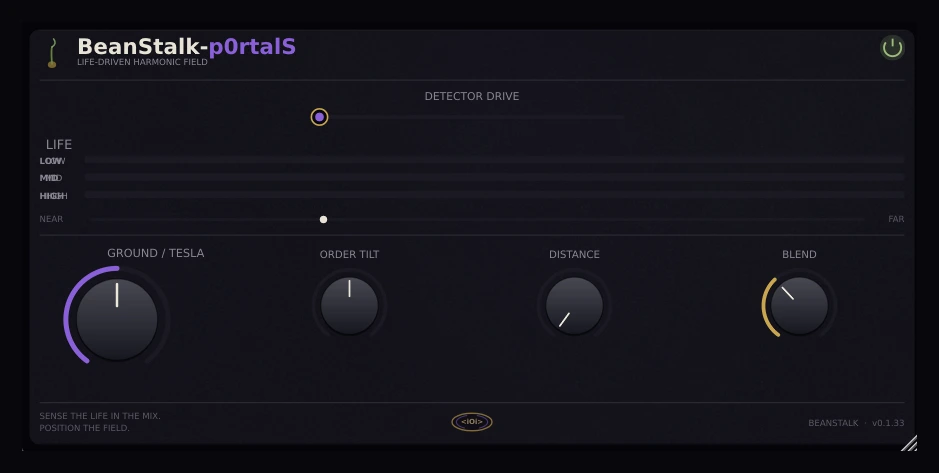
The BeanStalk-p0rtalS plugin interface: a wide near-black panel. Top-left a bean-sprout mark, then the title 'BeanStalk-p0rtalS' in cream and violet with the subtitle 'Life-driven harmonic field'. A green power light at top-right. A horizontal DETECTOR DRIVE slider across the top. Below it a LIFE section with LOW, MID and HIGH horizontal meter bars and a NEAR to FAR indicator strip. Then a row of four knobs: a large GROUND / TESLA knob with a violet arc, ORDER TILT, DISTANCE, and BLEND with a gold arc. The footer reads 'Sense the life in the mix. Position the field.' on the left, a small gold <iOi> lab badge in the centre, and 'BeanStalk · v0.1.33' on the right.
Default view. The band labels on the LIFE meter have a minor rendering overlap in this build — a cosmetic fix is pending.
The p0rtalS interface with the LAB drawer open: the main panel on top, and below the footer a second band with an 'ADVANCED' heading and an ADVANCED checkbox. It holds GROUND TILT and TESLA TILT sliders, GROUND and TESLA presence knobs each with an EXTENT knob, an ORBIT knob and a DISPERSE knob (violet-pink arc) in the centre, and a SOLO checkbox at the lower right.
The LAB drawer — the retired "Advanced" plugin, folded in as a toggle so its pitch-shadow chain only costs CPU when it's on.
How to use it

Where it earns its place.

Presence that reactsOn a vocal or lead, toward Fun with a modest Blend: the near field adds body and edge, but only leans in when the performance does. Quiet lines stay clean; the loud, expressive phrases get the harmonic lift.
A moving shadow on a static partOn a held pad or drone, toward Tesla with some Distance: the far 3/6/9 field drifts behind the sound and the micro-delay throw opens up whenever the part has any motion in it at all — life you didn't know was there.
Drum bus width & airLow Distance, Order Tilt up: the per-channel harmonic generation spreads the kit slightly and the HIGH band's reach adds detail on the hits without a broadband exciter's constant sizzle.
Reading a mixWatch the LIFE meter with Blend low. It's a genuinely useful diagnostic — which band is carrying the groove, whether the mix is actually moving or just loud, where the energy sits NEAR‥FAR.
Gentle material that needs waking upRaise Detector Drive so a soft acoustic guitar or a low-level bus still trips the detector. The field responds as if the part were louder — without the part getting louder.
Pitch-shadow textures (LAB)Turn on ADVANCED, add Orbit and Disperse: the field becomes a detuned, spreading pitch shadow orbiting the source — sound-design territory, well past subtle.
A few things to know before you download
What it isn't

Read this before you buy.

Not a level-triggered exciterIt responds to movement and impact, not amplitude. If your source is loud but perfectly static, p0rtalS will do very little — that's the design, not a fault.
Not a reverb or a delayThe micro-delays are 4–20 ms and carry only the harmonic field, never a feedback tail. This positions a shadow; it does not create space.
Not a pitch shifterThe harmonics come from a Chebyshev generator on the raw signal — no fundamental tracking, no transposition. (The LAB drawer's Orbit is the one exception, and it's opt-in.)
Not monoStereo in / stereo out only. The per-channel harmonic generation is part of how the field widens.
Technical details and verified specs
Technical

Verified specifications.

FormatsVST3 · Standalone application
Operating systemsWindows 10/11 (64-bit) · Linux (64-bit)
BuildsLegacy (broad CPU support) and v3 (AVX2; includes the Standalone). The Tesla engine is SIMD — AVX2 where available, SSE fallback.
ChannelsStereo in / stereo out only
LatencyZero reported latency. The internal micro-delays are part of the effect, not lookahead.
Sample ratesAny host rate
OversamplingNone. An always-on one-pole ultrasonic guard sits before the output.
BypassTrue host bypass (the buffer passes untouched); Blend at 0 is also silent-of-effect
CPULight in the default path (analyzer + Chebyshev + micro-delays). The LAB pitch-shadow chain only runs when ADVANCED is on.
Version0.1.33

Sense the life in the mix. Position the field.

p0rtalS is pay-what-you-want with a $20 suggested price. VST3 and Standalone, Windows and Linux — more platforms may follow.

Get p0rtalS on Gumroad

More BeanStalk plugins

See all plugins →