Three broad EQ bands and a LIFE control for movement and harmonics. Shape it by ear instead of fighting a pile of settings.
Character EQ · 1.0
An EQ made for listening.
Use LOW, MID, and HIGH to make broad tonal moves. LIFE adds an extra layer of harmonic movement that follows the material. Start with the EQ, then bring LIFE in if the track wants it.
Get BBeQ on GumroadVST3 + Standalone · Windows + Linux · more platforms may follow
BBeQ
Built byBean.S.talk · BeanStalk Audio
Statusv1.0.0 · Windows + Linux. More platforms may follow.
What is it?
So, what does it do?
Three simple EQ knobs shape the tone. LIFE adds a little extra harmonic movement when the sound could use more character.
New in 1.0
A new LIFE, and a new face.
The LIFE engine is new, and was chosen by ear. It listens to the finished EQ and finds the events in it, the hits and attacks. Low-end hits lift the top end through a SlewOnly lens, and top-end hits lift the low end through a SubsOnly lens. From about 40%, a Pafnuty harmonic character joins in, adding harmonics on the low-end hits. Because LIFE hears your EQ, your bells shape what it reacts to: boost the low end and LIFE hears more low-end hits. At 0 dB a bell changes nothing, LIFE included.
Two colour pills under LIFE pick the character. Red, D2, is the full Pafnuty character. Blue, D2 Light, is the same engine with the character 4.4 dB lighter. One is always lit, the LIFE ring takes its colour, and switching crossfades smoothly, so you can flip between them while the track plays.
The EQ is unchanged, and with LIFE at 0, 1.0 sounds exactly like 0.3, bit for bit. The new LIFE uses about a fifth of the old one's CPU. The original 0.3 LIFE engine, with its 45 bands and harmonic field, now lives on as its own plugin, BeanStalk-LIFE. The EQ side descends from analysis of Airwindows X2Buss; BBeQ is an independent implementation, not a clone or a port.
Signal Path
Three bells, then LIFE: the whole EQ feeds it.
The finished EQ feeds LIFE, LIFE sums back in after HIGH, and then SOLO and BLEND finish the path.
Three honest bellsEach band is two cascaded peaking biquads, each doing half the requested dB, at a fixed Q of 0.7. With no Q control, moving one band can never change another's bandwidth. Frequency and gain are smoothed over 20 ms.
Crossed eventsTwo event detectors follow the low band and the high band. Each one drives the opposite end of the spectrum: low hits move the top, high hits move the low end.
A late characterThe Pafnuty character rises with the square of LIFE, so it stays out of the way below about 40% and grows from there. Red is the full character; blue is the same, 4.4 dB lighter.
Both engines, always warmRed and blue run side by side all the time, so switching is a 20 ms crossfade, not a restart. At rest you hear the chosen one exactly.
Solo means soloWith Solo on, BBeQ outputs processed minus dry: the EQ's boost or cut plus LIFE, with the untouched signal removed. On a neutral setting that's true silence.
Blend and BypassBlend crossfades the processed signal against the dry input (100% by default; 0% is your untouched input). Host Bypass returns the input untouched.
Controls
Three bands, one macro, two utilities.
LOW — Frequency / Gain20 Hz–400 Hz · ±12 dBThe bottom bell. Sweep it to where the weight lives, then boost or cut. More low end here also gives LIFE more low-end hits to react to.
MID — Frequency / Gain200 Hz–5 kHz · ±12 dBThe body-to-presence bell. It overlaps LOW's top and HIGH's bottom on purpose.
HIGH — Frequency / Gain2 kHz–20 kHz · ±12 dBThe top bell, from upper-mid bite to air. Its hits are what move LIFE's low end.
LIFE0–100%, default 0 · knobRaises the crossed motion. The Pafnuty character joins from about 40%. At 0 it is bit-exactly neutral.
Red / blue pillsD2 · D2 LightThe LIFE character: red is the full Pafnuty character, blue is 4.4 dB lighter. The LIFE ring takes the pill's colour.
BLEND0–100%, default 100 · knobHow much of BBeQ's contribution reaches the output. Smoothed, so you can ride it.
SOLOtogglePlays only what BBeQ is contributing: the EQ move plus LIFE. It is silent on a neutral setting.
Interface
Orchid, with a spectrum in every ring.
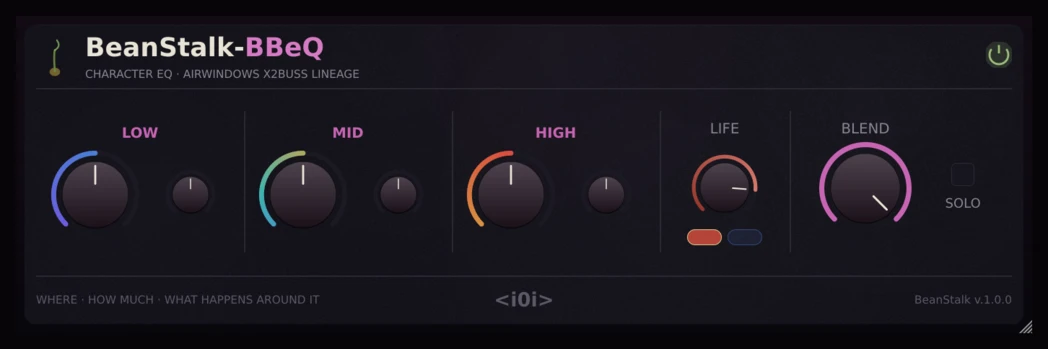
One compact row. LOW, MID and HIGH each have a large frequency knob with a small gain knob beside it. LIFE follows with its two pills under it, then a divider, then BLEND and SOLO. Each frequency ring is a colour sweep keyed to the actual frequency; the LIFE ring is a gradient of the lit pill's colour. It is drawn entirely with vector primitives in the shared BeanStalk family style, resizable and aspect-locked.
The 1.0 front panel: three bells with nested gain knobs, LIFE with its red / blue pills, BLEND and SOLO.Use it on
Where it earns its place.
Drum busRaise LIFE and the kick opens up the top while the hats move the sub. Flip to blue if the low mids get too busy.
Bass and kickPast about 40%, the red pill's character adds harmonics on every hit, so the low mids bounce with the playing.
Broad tone-shapingUse the bells as plain, wide EQ on anything. With LIFE at 0 they're a simple, honest three-band EQ.
Auditing your own movesSolo on a fresh setting is silence. Anything you hear is the change you've made.
A few things to know before you downloadWhat it isn't
Read this before you download.
LIFE sounds different from 0.3The 0.3 LIFE engine moved to its own plugin, BeanStalk-LIFE. A 0.3 session opens with every setting kept, but LIFE above 0 now sounds like the new engine.
The character is a high-LIFE thingBelow about 40% red and blue sound almost the same. The difference grows from there to 100%.
Not a surgical EQThe bells are broad and fixed-width. There is no Q control.
No output limiterStacked boosts can pass 0 dBFS. Watch your levels.
Technical details and verified specsTechnical
Verified specifications.
FormatsVST3 · Standalone application
Operating systemsWindows (64-bit) · Linux (64-bit)
DSP Lineage & Attribution: This plugin incorporates adapted DSP components from Airwindows (Chris Johnson, MIT licensed): Pafnuty2, SlewOnly and SubsOnly. No X2Buss code is incorporated. The specific components and applicable notices are documented in the included THIRD_PARTY_NOTICES.md. This does not imply endorsement by or affiliation with Airwindows.