BeanStalk Plugin

AntIp0p

Low-end events, lifted. AntIp0p finds the hits in your low end and lifts them.

Find the event, lift it

Track the low end. Lift what hits.

A kick, an 808, a bass note with a start: AntIp0p finds each low-end event in what you play and lifts it, with no latency. Behind the glyph is a second engine, J2, that reverses the event's own low end into a swell before the hit.

Get AntIp0p on Gumroad VST3 · Windows + Linux · more platforms may follow
AntIp0p
Built byBean.S.talk · BeanStalk Audio
Statusv0.1.1 · Windows + Linux. More platforms may follow.
What is it?

So, what does it do?

AntIp0p watches the low end for events: the moment a kick or a bass hit rises out of what came before. On each one it lifts the plugin's own low end, then lets it go over your Release. It is event-locked emphasis, not a bass boost, so the hits come forward and the space between them stays as it was.

Use it on drums, kicks, 808s and bass lines, or on a mix that has the hits but not the punch.

Curious how it works?
The Concept

Two engines, one detector.

A detector compares a fast and a slow read of the 35–180 Hz band. When the rise passes your Sensitivity setting, that is an event. EP, the engine that is always on, takes the signal's own low end (below 150 Hz) and lifts it with an envelope that attacks in 1 ms, holds to the crest of the hit, then releases over your Release. It is causal: zero latency.

J2 is the reverse approach. Before each event it reverses that event's own low end into an accelerating swell that runs into the hit. That needs the future, so while J2 is on the plugin reports 600 ms of latency to the host. Click the <i0i> glyph to turn it on. Its drawer adds Swell, J2 Blend, Hiss, Crack and Recession, and a Route choice: both engines on the dry signal (Shared), or J2 working on EP's lifted low end.

Signal Path

The dry signal never changes.

The lift is built from a copy of your signal and added to the untouched dry signal. At Blend 0, or in Bypass, the output is the input, bit for bit. With J2 off there is no latency and no look-ahead.
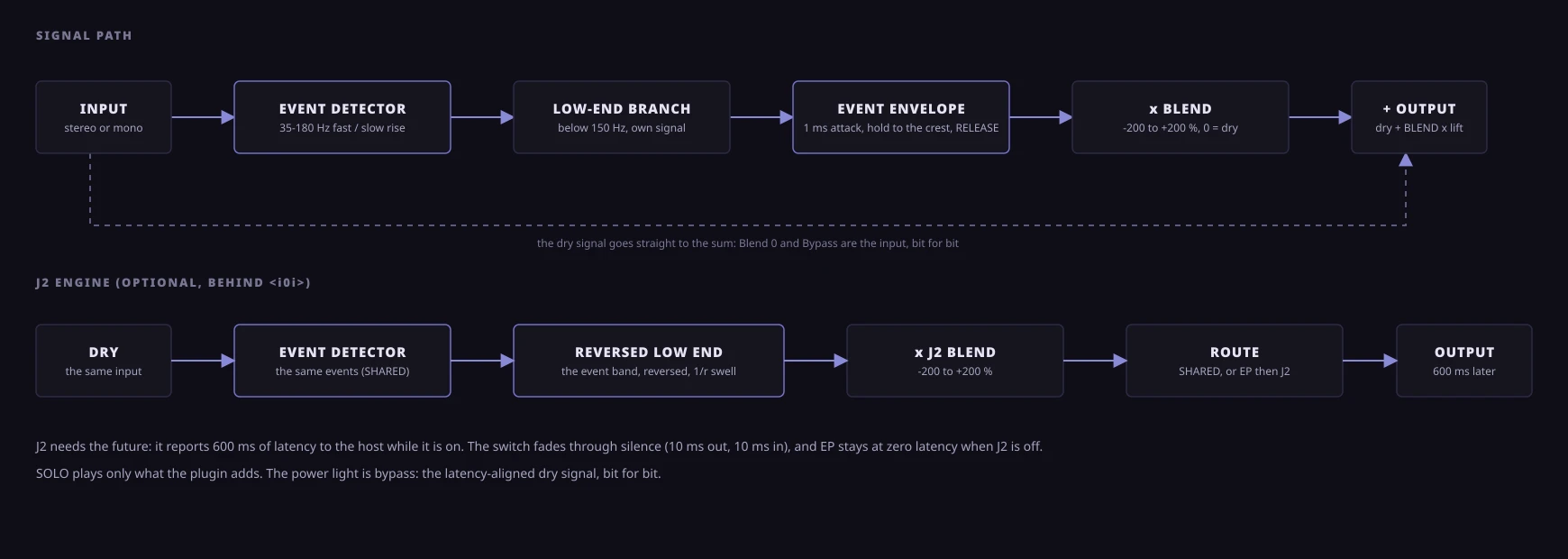
AntIp0p signal flow. Top row: the input feeds an event detector (35 to 180 Hz, fast against slow rise) and a low-end branch (below 150 Hz); the event envelope shapes the branch, it is scaled by Blend and added to the dry input to make the output. The dry input also goes straight to the sum. Bottom row, optional: the dry input and the same events feed J2, which reverses the event's low end into a swell, scaled by J2 Blend, with a Route choice, and the output arrives 600 ms later.
Detector, low-end branch, event envelope and Blend, added to the untouched signal. J2 is the optional second row.
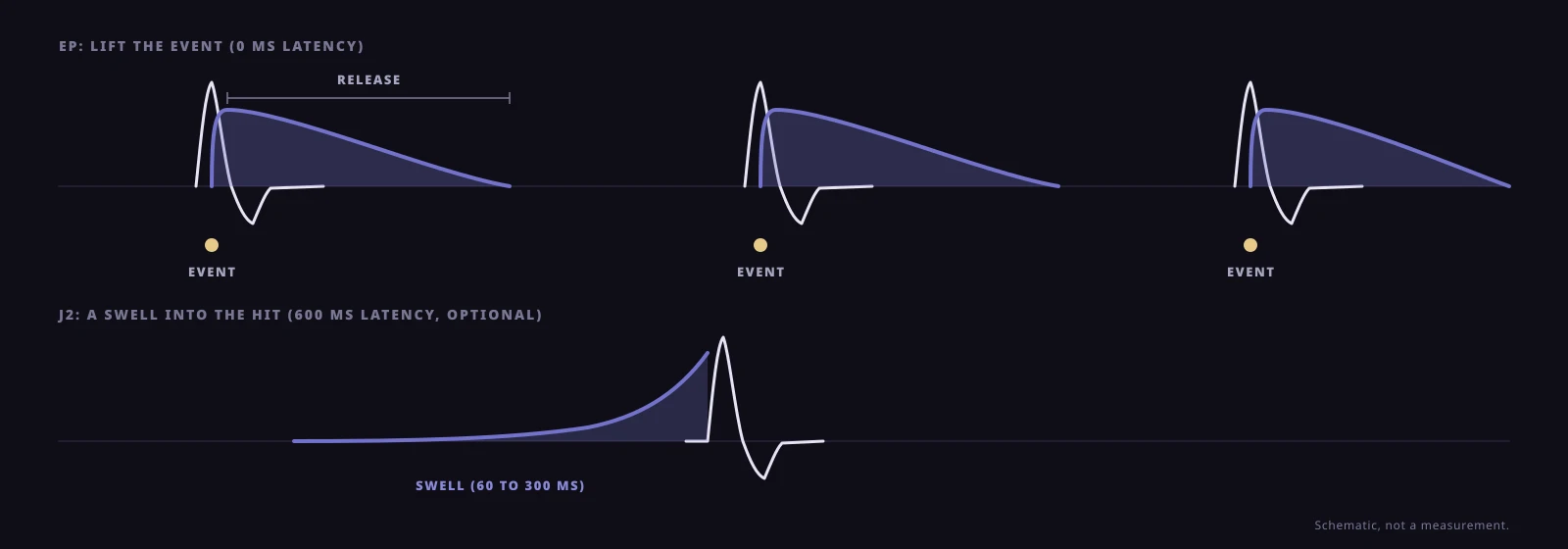
A schematic timeline. Top: three low-end hits, each with a gold event marker below it, and under each a violet lift that rises just after the hit and decays over Release. Bottom: one hit preceded by a violet swell that grows slowly, then sharply, into the hit.
EP lifts each event; J2 swells into it. Schematic, not a measurement.
Controls

Three knobs, one switch, and a drawer.

Sensitivity12 … 3 dB, default 7How big a rise counts as an event. Clockwise means more events. The light beside the knob flashes on every event it finds. 4.5 suits dense mixes.
Release10 … 400 ms, default 60How long the lift lasts after each event's crest.
Blend−200 … +200 %, default +60The lift amount. 0 is the input, bit for bit; 100 % is a 6 dB lift during the event. Below 0 the lift inverts.
SolotogglePlays only what AntIp0p adds.
Power lightbypassThe latency-aligned dry signal, bit for bit. The detector keeps running, so re-engaging is not cold.
<i0i> → J2click the glyphOpens a menu to turn the J2 engine on or off. On adds the drawer and 600 ms of latency.
J2 drawerSwell · J2 Blend · Hiss · Crack · Recession · RouteSwell 60–300 ms; J2 Blend −200…+200 %; Hiss, Crack and Recession are optional parts, off by default; Route is Shared or EP → J2.
Interface

Indigo, with a light for every event.

One compact row: Sensitivity on the left with its event light, Release and Blend beside it, Solo in Blend's corner. The sprout shows the value readouts. The J2 drawer takes no room while J2 is off. It is drawn with vector primitives in the shared BeanStalk family style, resizable and aspect-locked.
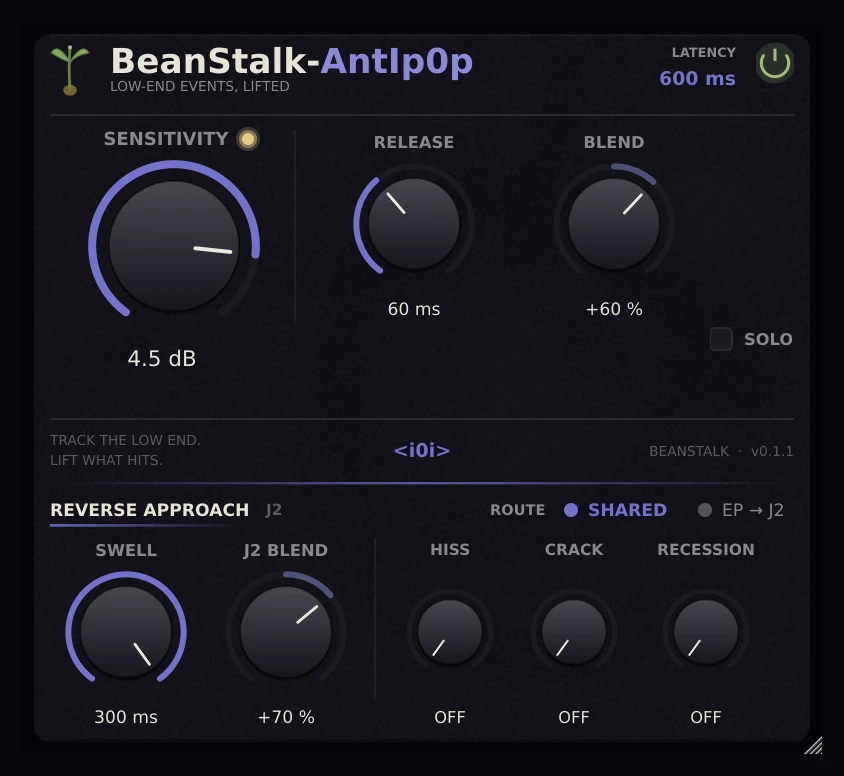
The BeanStalk-AntIp0p front panel with J2 on: a compact near-black panel. Top left, a small bean-sprout mark; the title 'BeanStalk-AntIp0p' with 'AntIp0p' in indigo and the subtitle 'LOW-END EVENTS, LIFTED'; LATENCY 600 ms and a power icon top right. A large SENSITIVITY knob with a small gold event light beside its label, then RELEASE and BLEND knobs and a SOLO checkbox. Footer: 'TRACK THE LOW END. LIFT WHAT HITS.', a centred '<i0i>' and 'BEANSTALK v0.1.1'. Below, the J2 drawer: REVERSE APPROACH with ROUTE choices SHARED and EP to J2, knobs SWELL and J2 BLEND, and HISS, CRACK and RECESSION.
The front panel with J2 on and the value readouts shown.
A few things to know before you download
What it isn't

Read this before you download.

No output limiterOn purpose. EP adds peaks more than loudness. At the default Blend, the 4×-oversampled peak rose by up to 3.4 dB on the most percussive test material in our measurements. Leave headroom, or turn Blend down.
J2 costs 600 msWhile J2 is on, the plugin reports 600 ms of latency and your host compensates. Switching it fades through silence (10 ms out, 10 ms in), so switch while stopped when you can.
J2 wants spaceThe swell needs room before the hit. On sparse material like drums and kicks it adds about 15 dB more low end in the 300 ms before a hit; on dense mixes there is little room, and the effect is small.
Timing follows the detectorOn a dense live mix the detector can fire about 23 ms after the crack. The lift then lands just after it. On close-miked drums it is within a few milliseconds.
Technical details and verified specs
Technical

Verified specifications.

FormatVST3
Operating systemsWindows (64-bit) · Linux (64-bit)
ChannelsMono or stereo, in and out
Latency0 ms with J2 off · 600 ms with J2 on, reported to the host
Sample ratesAny host rate; tested at 44.1 / 48 / 88.2 / 96 / 176.4 / 192 kHz
OversamplingNone
Neutral behaviourBlend 0 and Bypass are the input, bit for bit (latency-aligned)
CPUUnder 1 % of one core at 48 kHz stereo, J2 on or off (an upper bound; plugin load included)
Version0.1.1

Low-end events, lifted.

VST3, Windows and Linux. More platforms may follow.

Get AntIp0p on Gumroad

More BeanStalk plugins

See all plugins →