0utZ
Three lenses, with a ceiling. 0utZ is the 0utS chain with a peak stage on every lens and on the output.
Hear three sides of a sound. Keep each one in bounds.
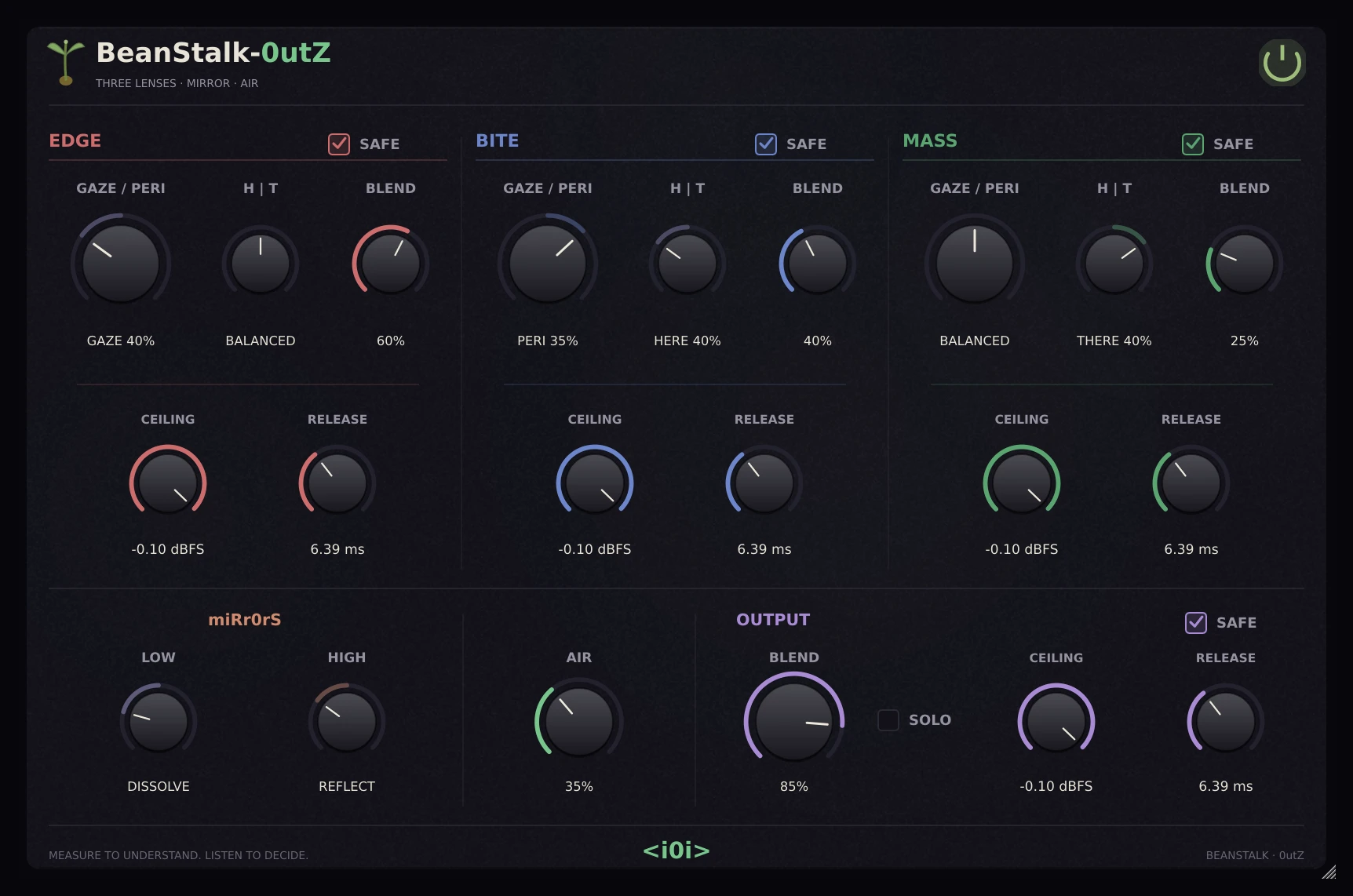
0utZ runs the same three listening lenses as 0utS, EDGE, BITE and MASS, blended onto your dry signal, then miRr0rS and AIR. The difference: each lens, and the output, has its own SAFE stage, a short look-ahead peak ceiling you can switch on or off.
Get 0utZ on Gumroad Pay what you want · free · VST3 · Windows + Linux · more platforms may followSo, what does it do?
Each lens reads the same input and adds its own character onto the untouched dry: EDGE is what is moving, BITE is the detail in the peaks, MASS is what is down there. A lens's own Blend is the only thing that sets its level, so with every Blend at zero the chain is your signal.
0utZ adds a peak stage to each lens branch and one after the whole chain. They are meant to keep the lenses from adding spiky peaks to the mix without flattening the sound. They are sample-peak ceilings, not a mastering limiter.
Curious how it works?
Same chain as 0utS. Peaks held in four places.
The lens, trim and blend arithmetic is the 0utS arithmetic. In 0utZ the EDGE, BITE and MASS branches each run through their own look-ahead peak stage (0.33 ms look-ahead), and a fourth stage follows global Blend and Solo at the output. The four stages are fully independent: no shared detector, release or state. The factory ceiling is −0.1 dBFS and the release 6.39 ms; both are adjustable per stage.
The MASS branch uses the simpler original peak stage; EDGE and BITE use the newer one. The stages keep running while switched off, so turning one on does not start from cold.
Dry stays. Lenses sit on top. Peaks are held per stage.
Every lens reads the same dry input, is trimmed, blended and held to its ceiling, then added onto the dry. miRr0rS and AIR follow, then the output Blend and a final ceiling.

Three lenses, a mirror, air, and the ceilings.
Sea-glass and dark, a ceiling pair under every section.
The same family look as 0utS, one colour per lens. The footer glyph opens the ceiling and release pair under each lens and under Output, and gives the height back when closed. Resizable and aspect-locked; everything scales together.