BeanStalk Plugin

cL0CkR

Three delay taps—left, center, and right—with a pitch-changing feedback path. From tiny timing shifts to echoes that keep changing.

Three taps · One return

Three taps. One restless return.

Set a delay for the left, center, and right positions. Feed the repeats back through the pitch section to make each return behave differently.

Get cL0CkR on Gumroad Pay what you want · free · VST3 + Standalone · Windows + Linux
cL0CkR
Built byBean.S.talk · BeanStalk Audio
Statusv0.2.0 · Windows + Linux — more platforms may follow
What is it?

So, what does it do?

Three delay taps—left, center, and right—feed a return that can change pitch. Start with tiny timing shifts, or let the echoes wander.

Curious how it works?
The concept

The first repeat is clean. The pitch builds.

The wet signal you hear is taken before the pitch stage, so the first repeat is always unshifted. Pitch lives only in the feedback return: each time the signal goes round the loop it is shifted once more, so the second repeat is shifted once, the third twice, and so on. A small shift sounds like a drifting, detuned echo; a large one climbs or falls away.
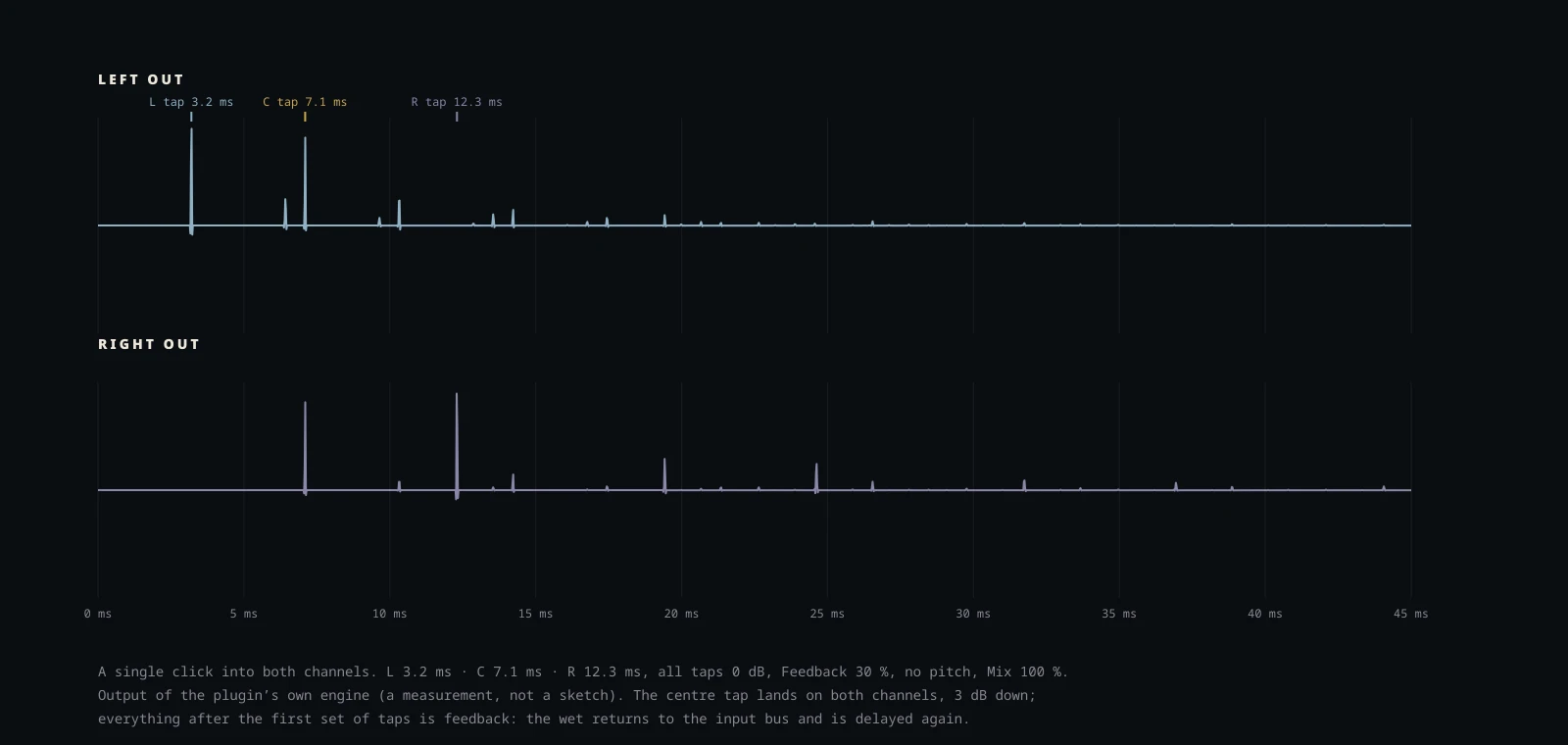
Two stacked waveform traces on a dark background, LEFT OUT in pale blue and RIGHT OUT in violet-grey, from 0 to 45 milliseconds. Sharp spikes mark a left tap at 3.2 ms, a centre tap at 7.1 ms on both channels and a right tap at 12.3 ms, followed by many smaller spikes that are the feedback repeats.
A measurement, not a sketch: the plugin's own engine fed a single click into both channels — L 3.2 ms, C 7.1 ms, R 12.3 ms, all taps at 0 dB, Feedback 30 %, no pitch, Mix 100 %.

The centre tap shows up on both channels (3 dB down each); everything after the first set of taps is the feedback return, delayed again.

Signal flow

Taps, mix — and a pitched loop.

The wet signal goes straight to MIX. A copy of it, passed through Mid/Side pitch, a DC block, FEEDBACK and a safety limiter, returns to the write bus.

Signal flow: stereo in plus the feedback return forms the write bus; three delay taps L, C and R (C fed by the mono sum, 3 dB down each side) form the wet signal, which goes straight to MIX and OUTPUT and also, through a mid/side pitch stage, a DC block, FEEDBACK and a safety limiter, back to the write bus.STEREO INL and RWRITE BUS + TAPSx = in + feedback returnL tap 1 µs–100 ms, LEVELC tap fed by (L+R)/2R tap 1 µs–100 ms, LEVELwet = L/R tap + 0.7071·CMIX / SOLOout = OUTPUT · ((1−MIX)·in + MIX·wet)SOLO = OUTPUT·MIX·(wet−in)wet is taken BEFORE pitchOUTFEEDBACK RETURNwet → M/S pitch (MID ±12 st, SIDE ±12 st) → DC block→ FEEDBACK → safety limiter → write busapplied feedback = min(FEEDBACK, 0.98 / loop gain)
Wet before pitchThe signal you hear first is never pitch-shifted; pitch is heard through recirculation.
A loop-gain ceilingThe feedback actually applied is capped at 0.98 ÷ loop gain every sample, so the loop can't run away.
Mix opens at zeroA freshly loaded cL0CkR is a bit-exact pass-through until you raise MIX.
Zero reported latencyThe delay is the effect; the host is told 0. (The pitched loop has 8 ms of shifter delay inside it.)
Controls

Three taps, one return, one mix.

LEFT · CENTER · RIGHT time1 µs – 100 ms · logWhere each tap sits. LEFT is heard on the left, RIGHT on the right, CENTER on both. Logarithmic, so it's even-feeling across the range.
Tap LEVEL−60 dB (off) … +6 dBEach tap's level. −60 dB switches that tap off.
MIX0 – 100 % · opens at 0Delayed signal against your dry input. At 0 % the plugin is a bit-exact pass-through.
FEEDBACK0 – 98 % requestedHow much of the wet signal returns to the input. The effective maximum depends on tap levels (see below).
MID PITCH · SIDE PITCH±12 semitones eachPitch-shift the mid and the side of the feedback return, independently. 0 is neutral.
OUTPUT±12 dBOverall output level.
SOLOdrawerPlays only what the plugin is adding — the delayed material at the MIX level. Silent at MIX 0 %.
TIME rangeµs | ms · drawerA display lens on the TIME knobs: µs = 1 µs–1 ms, ms = 1–100 ms, for finer travel. Switching clamps each tap into the new range.
The bean-sprout marktop-leftClick to reveal every numeric readout. Dormant by default.
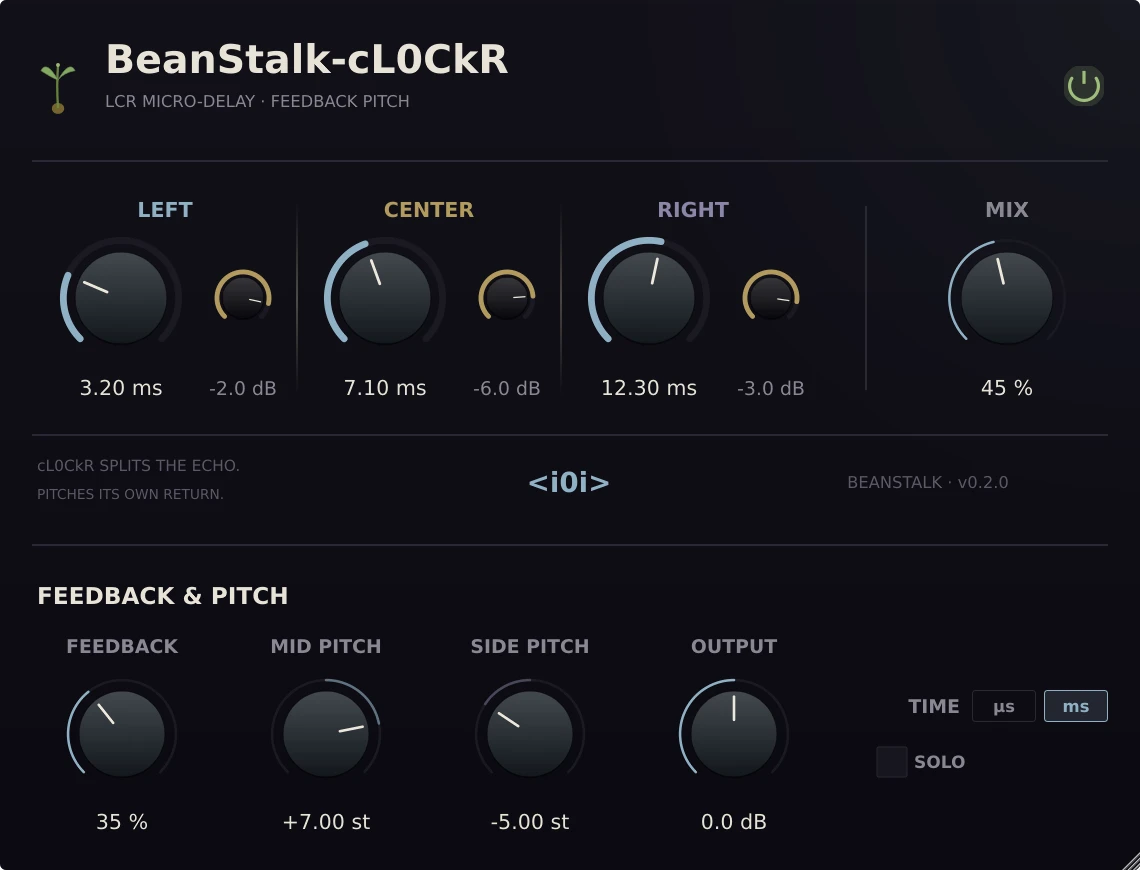
The <i0i> markfooter, dead centreClick to open the drawer: Feedback, Mid Pitch, Side Pitch, Output, TIME range, Solo.
BYPASSheader power lightGreen while on, dim grey when bypassed. A 10 ms crossfade; bit-exact pass-through once settled.
A closer look at the controls
The Interface

Chrono ice and dark. Part of the BeanStalk family.

The panel opens compact, with the values hidden. The whole thing scales as one — every label, knob and toggle grows and shrinks together.
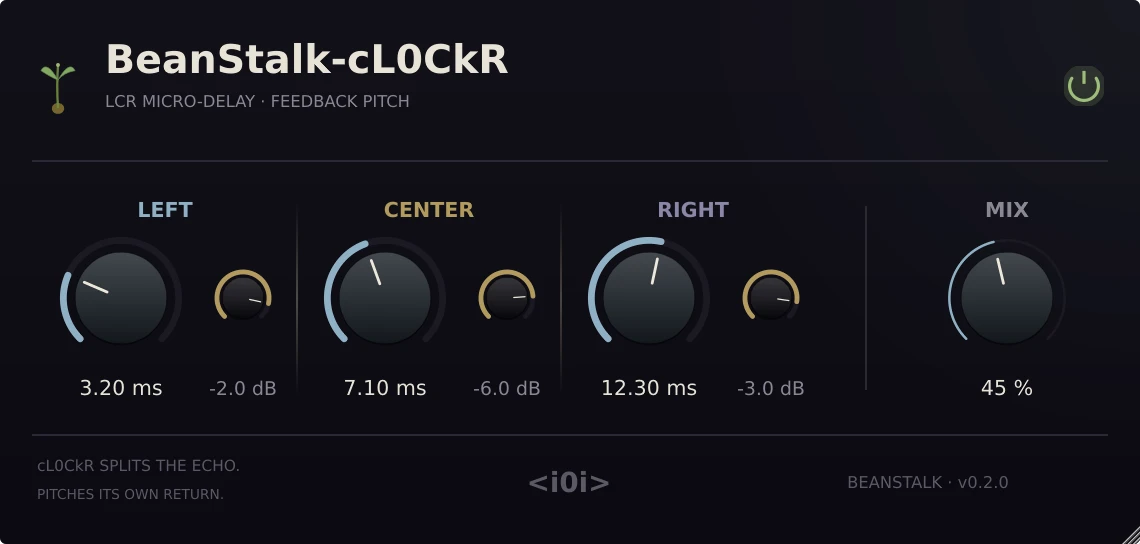
The BeanStalk-cL0CkR front panel: a dark bar with the title in cream, the subtitle 'LCR MICRO-DELAY · FEEDBACK PITCH', a bean-sprout mark at top-left and a green power light at top-right. Three tap columns LEFT, CENTER and RIGHT, each with a large time knob and a small level knob, then a MIX knob after a divider, and a footer with the i0i mark at the centre.
The front panel with the readouts shown (a render of the plugin's own editor; demo settings).
The same panel with the drawer open below the footer: a FEEDBACK AND PITCH section with FEEDBACK, MID PITCH, SIDE PITCH and OUTPUT knobs, a TIME µs and ms switch, and a SOLO checkbox.
The drawer — Feedback, Mid Pitch, Side Pitch, Output, TIME range and Solo. Same window, just taller.
How to use it

Where it earns its place.

Micro-stereo and comb filteringSet the taps in the microsecond range at slightly different times, MIX around the middle, and listen to the spectrum change — a different colour on each side.
Haas wideningA tap of a few milliseconds on one side, a different one on the other, no feedback: the image widens without obvious echoes.
Slapback and echoesTens of milliseconds, a little FEEDBACK, and a tap level or two pulled down for repeats that fade.
Drifting echoesA small MID PITCH or SIDE PITCH (a fraction of a semitone) in the return makes each repeat detune a touch more than the last.
Spreading repeatsMID up and SIDE down, or the reverse: the repeats move apart as they recirculate.
Hear what you didSOLO plays only what the plugin is adding, so you can hear the taps and the return without the dry signal.
A few things to know before you download
What it isn't

Read this before you download.

Feedback has a ceilingThe applied feedback is capped so loop gain never exceeds 0.98. With all three taps at 0 dB the practical maximum is about 57 %; turn the taps down and it opens up toward 98 %.
Short taps get loudMicrosecond taps with feedback can be several dB louder than the dry signal. Watch your output.
The shifter has a characterIt is a crossfading two-tap shifter with a slight, tone-dependent tremolo, and 8 ms of delay in the loop when pitch is active. It is not a transparent pitch shifter.
Pitched feedback can build low endLarge, opposite Mid and Side shifts recirculating can accumulate low-frequency content. Keep an eye on it.
Not a tempo delayThere is no sync or note-value setting. Times are set in microseconds and milliseconds.
Early releasev0.2.0. The DSP is measured and tested, but it has not been run in every host.
Technical details and verified specs
Technical

Verified specifications.

FormatsVST3 · Standalone application
Operating systemsWindows (64-bit) · Linux (64-bit)
ChannelsStereo in, stereo out
Latency0 samples reported to the host
TapsL / C / R · 1 µs – 100 ms (log) · level −60 … +6 dB
Feedback returnMid / Side pitch ±12 st · DC block · safety limiter · loop gain ≤ 0.98
CPUDSP engine ≈ 0.7 % of one core at 48 kHz (measured on the test machine)
Bypass10 ms crossfade; bit-exact pass-through once settled
AutomationAll controls, Solo and bypass are host-automatable
BuildsTwo tiers per platform: a legacy VST3 for any 64-bit CPU, and a VST3 + Standalone build for CPUs with AVX2
Version0.2.0

Split the echo. Pitch its own return.

cL0CkR is pay-what-you-want, and free is a fair price. Three taps, a pitched feedback return, and a Solo that plays only what it adds — VST3 and Standalone, Windows and Linux. More platforms may follow.

Get cL0CkR on Gumroad

More BeanStalk plugins

See all plugins →